Less copper
More wireless for comfort and lighting. The McConaghy MC86GT installation is described with over 4,000 ft less cable than a traditional build.
You pick the equipment. Quasar sets the framework.
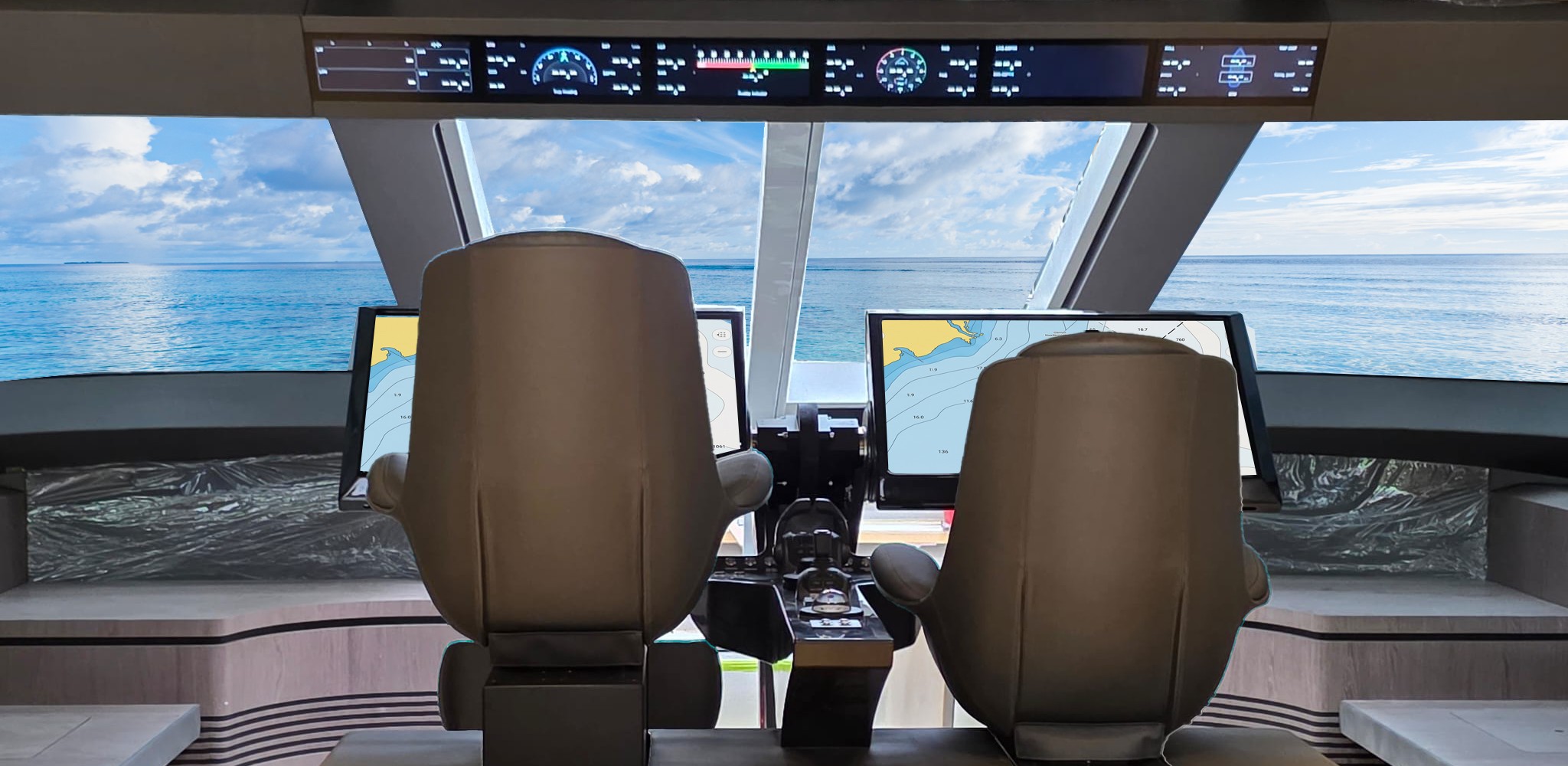
Bring power, switching, HVAC, engines and cameras into one open system, with unified displays from the cabin to the helm. Give the owner one app and a boat that is simpler to use.
Quasar Marine brings Glass displays, ONE and the Quasar Twin, and Master integration together. Equipment, installation and services are specified for your boat.
More wireless for comfort and lighting. The McConaghy MC86GT installation is described with over 4,000 ft less cable than a traditional build.
The Marine system brings the same widgets to displays from 4 in to 22 in: cabin, saloon and the ribbon above the helm.
Give owners, crew and guests a common view of the connected boat. Onboard help can operate without internet with the appropriate local AI hardware.
Figures come from the October 2026 Marine brochure. The engineering reduction is a target; MC86GT cable and configuration figures describe that project.
Every connected system joins the boat's local framework. The displays share its picture; connected cloud services add the Twin, vessel history and remote support.
Quasar ONE collects readings on board for Quasar Twin to compare with the boat's history. Quasar Master connects supported systems and runs local scenes and automations.
Explore Quasar Master and the optional Local AI processor.
Quasar Twin compares readings with your boat's own history to show changes in context. The vessel log keeps a timestamped record of starts, stops and faults for owners and service agents to review.
Conceptual architecture. Connected systems, display options and supported functions are confirmed for each boat. Cloud functions need connectivity; onboard voice and vision require the specified Master hardware option.
A 4 in display needs only 12 V power. Bring up the widgets for the connected items the owner wants to monitor or control.
Bring marine IP camera views to the glass. Supported webOS screens join the unified display system, including saloon layouts with media and navigation.
Keep a timestamped history of starts, stops and faults for service, the surveyor and the next buyer. The vessel log is a subscription service after the first year.
Electric steering is described with rudder feel at the helm and up to four stations. The Marine brochure cites a 90% energy saving compared with hydraulics.
Advanced software controls energy recovery through patented DC-DC technology. The Marine brochure describes 60%+ more energy than sail drives.
The proposed sailing layer combines waypoint sailing with cameras and radar for docking, with lidar and phase-coherent sensing described from 40 m to 200 mm.
These are the capabilities and performance figures described in the Marine brochure, not a universal specification for every hull. Agree the equipment, operating envelope and commissioning requirements for your build with Safiery.
Supported open systems and their local device rules.
Power, switching and selected camera views at the helm.
ONE retains readings. Master adds Home Assistant and local scenes.
Connected on-board roles, not a serial data path. Supported equipment supplies readings to ONE; Glass is a display and control interface, not a required relay to the cloud.
Readings cross this boundary when connected ↓
History, trends and proposed assistance.
The owner confirms before an AI proposal is applied.
One traceable record of the finding and outcome.
Conceptual architecture from the Marine and ONE brochures. Confirm connected systems for each build. Gensets and watermakers have no remote command path; HVAC is request-only.
Token rates, payment terms and an account-linked upload and review service must be confirmed before you can order. No AI service charge is included in a Glass hardware cart.
The brochure describes this service: send photos, lists and a spreadsheet. The AI service centre does the work and sends a link for you to check. Each service is priced separately, based on the AI tokens used.
Upload photos for a 3D image of your own boat. Choose the items to animate, photograph products and serial numbers to find manuals, and describe your rules.
Review each returned image, highlighted item, manual and condition. Accept it or ask for a redo.
Use the service's spreadsheet template to list device name, location, device ID, channel and digital output. Upload it for review.
You confirm before the AI configures the system. Afterwards, you receive a link to the configuration tables. Supported open systems include STAR, Shelly and Victron through a GX device, plus Matter through Master.
Link your Quasar ONE ID and upload the service companies you use, with the products each company covers. A photographed list or spreadsheet works.
Review the returned mapping of service companies to the equipment on your boat.
This page describes the brochure's process. It does not provide service login, payment registration, spreadsheet download, uploads or configuration approval. Do not send credentials or payment details through an enquiry.
The described AI harness uses Anthropic to prepare the work and OpenAI to check the same boat data and Safiery's rules independently, without the first model's reasoning.
Nothing reaches the boat until the owner confirms. The boat applies its own device rules and records the outcome in the vessel log.
| Device class | Control described by the AI harness |
|---|---|
| Lights, fridges and pumps | Remote switching through the harness |
| HVAC plant | Request only; the boat sequences it |
| Gensets and watermakers | No remote command path |
Conceptual service architecture. AI Treats use open protocols; closed systems are not configured. AI-token charges are separate from hardware and from the vessel-log subscription after the first year.
An 86 ft power catamaran with unified displays and 300 digital switching points. The brochure lists October 2026 as its on-water milestone.
The full Quasar system, with delivery planned for May 2027.
Tell us about your boat, the systems you want to connect and your build schedule. If you have a general arrangement or equipment list, let us know. We'll help define the right integration scope.
Or speak with our team: +61 7 2102 2553 · sales@safiery.com
Looking for configuration services? Explore AI Treats · Visit the Quasar website