


Tank Measurement Methods: Ultrasonic vs. Radar Technology - Which Is More Accurate?
Radar technology delivers higher accuracy in challenging tank environments, achieving 1mm repeatability compared to ultrasonic sensors that typically range from 5-10mm accuracy under optimal conditions. When measuring tank dimensions, it is important to measure from the bottom of the tank to the liquid surface to get an accurate reading, and to use precise units such as mm or cm. The available space inside the tank, including internal space and wall thickness, must be accounted for to determine the maximum liquid volume. The difference becomes more pronounced when foam, vapor, or temperature variations are present—conditions common in marine and RV applications where reliable tank volume readings matter most. Note that tank geometry (cylindrical, rectangle, sphere, dome, etc.) and tank height are key factors in volume calculations, and multiplying the relevant dimensions (such as length, width, and height for rectangles, or radius and height for cylinders) gives the total volume. For example, the volume of a rectangular prism-shaped tank is calculated as V = lwh, and for a cylinder-shaped tank, V = πr²l. For complex shapes, such as tanks with dome tops or spherical sections, the total volume is calculated by dividing the tank into regular components (rectangles, cylinders, domes, spheres) and summing their volumes. When determining the filled volume, you replace the tank height with the observed liquid height in the formula. Tank volume calculators allow you to enter measurements in mm, cm, or other units, and the calculator matches its output to your preferred units and application needs. When calculating the fill volume of oval tanks, you often assume the tank is made up of two halves of a cylinder separated by a rectangular section to simplify the calculation.
The Absolute Biggest Difference is Radar performs well on Black Water tanks
Most blackwater tanks are poly ethylene vs poly propylene. Virtually nothing sticks to polyethylene except a brown film builds up over time.
Safiery’s STAR-Tank works exceptionally well in these tanks.
See Video below.
Below is a practical comparison of ultrasonic vs radar tank measurement methods.
Types of Tanks and Their Shapes
The Tank Volume Odyssey: My 25-Year Journey from Guesswork to Precision!
After spending over two decades wrestling with liquid storage challenges across everything from RV adventures to marine installations, I’ve discovered that tanks are like personalities—they come in a stunning variety of shapes and sizes, each one demanding its own unique approach. Whether you’re dealing with a water tank that’s been your faithful companion on countless RV journeys, a fuel tank that’s seen you through stormy seas, or an industrial storage vessel that’s the backbone of your operation, understanding your tank’s shape becomes absolutely critical for nailing down that elusive tank volume and total capacity. Trust me, I’ve learned this the hard way!
The Shape Chronicles: Each One Tells Its Own Story
In my adventures, I’ve encountered the full cast of characters in the tank world. There are the stalwart vertical cylinders standing proud like sentinels, the practical horizontal cylinders lying in wait, the dependable rectangles with their no-nonsense approach, the elegant ovals that seem to whisper efficiency, and the sophisticated capsules that look like they belong on a spaceship. Each shape has its own personality and secrets, which dramatically influence how you crack the code of volume calculation and ultimately determine how much precious liquid that tank can embrace. I remember my first encounter with a vertical cylinder tank during my early water storage days—it was love at first sight! Meanwhile, those oval tanks and vertical capsule tanks I’ve found lurking in specialized marine applications always reminded me of hidden treasures waiting to reveal their mysteries.
The Calculator Revolution: My Digital Salvation
Let me tell you about the game-changer that transformed my entire approach—the tank volume calculator! After years of wrestling with complex formulas and making embarrassing miscalculations that cost me time and money, discovering these digital wizards was like finding the Holy Grail. These remarkable tools are designed to tame the wildest variety of tank shapes, allowing you to feed in dimensions like length, width, height, diameter, or radius using whatever units speak your language—millimetres, centimetres, metres, inches, or feet. The calculator then works its magic, delivering tank capacity and liquid volume in units that make sense: litres, cubic meters, UK gallons, US gallons, or cubic feet. It’s like having a mathematical genius in your pocket!
The Formula That Changed Everything: My Vertical Cylinder Breakthrough
I’ll never forget the day I finally mastered the vertical cylinder calculation. Picture this: measuring the diameter and height, then applying the beautiful formula that became my daily companion: V(tank) = π × (radius)² × height. When I encountered my first tank with a diameter of 1 meter and a height of 2 meters, I felt like an explorer discovering new territory. First, I found the radius (0.5 meters), squared it with reverence, multiplied by that magical π, and then by the height to reveal the total capacity in cubic meters. Bingo! The calculator then converted this treasure to litres or gallons faster than I could blink. That moment was pure engineering poetry.
Conquering the Complex: When Shapes Fight Back
But life threw me curveballs with the more complex shapes that seemed designed to humble my confidence. The vertical capsule tank became my nemesis—a calculation that demanded combining the volume of a cylinder with two half-spheres, like solving a three-dimensional puzzle. And don’t get me started on horizontal oval tanks! You have to calculate the area of the end (which resembles a stadium shape, if you squint just right) and multiply by the length to estimate the total volume. These calculations nearly broke my spirit when attempting them by hand, but my trusty tank volume calculator became my knight in shining armor, streamlining the entire process and ensuring accuracy regardless of whatever twisted shape the tank gods threw at me.
The Measurement Crusade: Where Precision Meets Passion
Here’s where I learned the hard truth that nearly cost me everything: accurate measurement of your tank’s dimensions—whether it’s the height, length, width, or diameter—is absolutely crucial. I discovered this during a particularly painful lesson when small errors in my measurements led to massive discrepancies in calculated tank capacity. The stakes were especially high when dealing with large tanks or when precise liquid volume was mission-critical for my application. That day taught me that in the tank world, there’s no room for “close enough”—it’s precision or pain.
Victory at Last: The Sweet Taste of Mastery
After all these years of battle-testing tank size calculators and religiously entering correct measurements and units, I can now confidently determine the total capacity and liquid volume of any tank that crosses my path—whether it’s a faithful water tank, a reliable fuel tank, or any other storage vessel that demands respect. This hard-won knowledge ensures I always know exactly how much water or liquid I can store, fill, or monitor, supporting superior planning and resource management for all my off-grid adventures, marine expeditions, and industrial challenges. The tank has become my trusted ally, not my mysterious adversary.
Ultrasonic vs Radar Tank Measurement: Key Differences
The main difference comes down to signal penetration versus surface reflection.
Ultrasonic measurement relies on sound waves bouncing off liquid surfaces, requiring a clear acoustic path between the sensor and the water level.
Radar measurement uses radio frequency signals that can penetrate foam, vapor, and non-metallic tank materials to calculate the volume accurately.
Both approaches can provide accurate readings, but the measurement experience differs significantly depending on tank conditions and installation requirements.
Signal Penetration and Accuracy
Signal penetration is one of the most important factors when selecting tank measurement technology.
Ultrasonic Water Tank Measurement
Ultrasonic sensors require a clear acoustic path between the sensor and the liquid surface. Sound pulses travel through air at frequencies typically between 20kHz and 200kHz, bouncing off the liquid to determine tank level.
Foam, vapor, and agitation can interfere with sound wave transmission. In grey and black water tanks, foam is almost always present above the liquid line, and ultrasonic sensors cannot penetrate it reliably.
Accuracy is affected by temperature variations and air density changes. The speed of sound in air shifts approximately 0.37% per degree Celsius, introducing measurement errors of roughly 3% per 6°C change if not compensated.
Under optimal conditions—clean liquids, stable temperatures, no foam—ultrasonic sensors typically achieve accuracy within 15-30mm. In less ideal settings, errors widen considerably, making it difficult to calculate the volume with confidence.
Radar Tank Measurement
Radar signals penetrate foam, vapor, and most non-metallic tank materials including polyethylene, fibreglass, and ABS. This allows measurement directly through tank walls without penetration.
60GHz frequency provides high resolution and immunity to environmental interference. At this frequency, the sensor can detect small changes in water level with precision that ultrasonic methods cannot match.
Phased coherent radar technology—where the system maintains a constant phase relationship between transmitted and received signals—enables 1mm repeatability. This coherent integration dramatically improves sensitivity and range resolution.
Performance remains consistent regardless of liquid surface conditions, foam thickness, or temperature variations. Whether measuring fresh water, grey water, or black water, radar delivers reliable readings.
Installation Requirements and Complexity
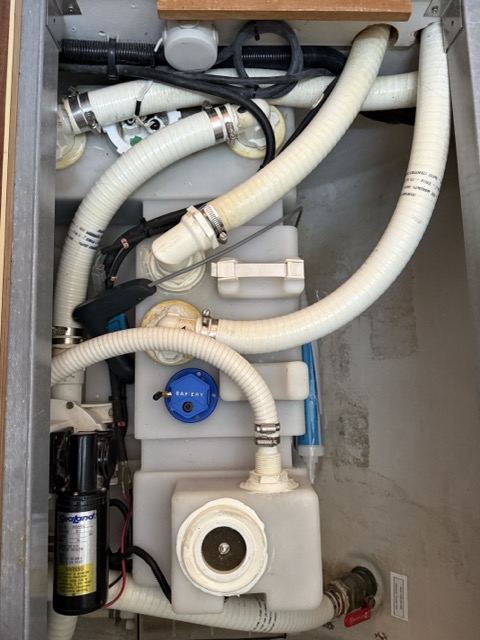
This location on a black water tank works
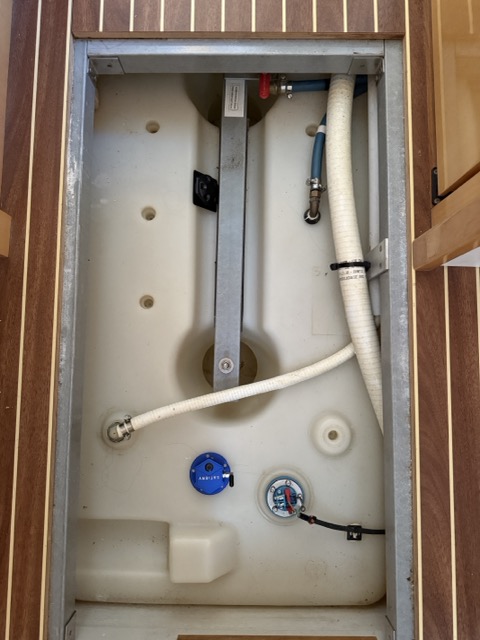
This location on a catamaran fresh water tank works well
Installation ease creates different challenges for ultrasonic and radar systems.
Ultrasonic Sensor Installation
Ultrasonic sensors require precise mounting position with an unobstructed path to the liquid surface. Any tank baffles, protrusions, or wall angles can reflect or block sound waves.
The sensor needs acoustic coupling medium like grease or adhesive for proper signal transmission. Moisture condensation on the transducer face can degrade signal quality over time.
Power wiring through tank walls or vessel hull is required. Multiple conductors increase installation complexity and create potential failure points, particularly in marine environments where corrosion is a constant concern.
Blind zones—the minimum distance from the sensor where measurement is unreliable—typically range from 300-500mm for ultrasonic sensors, limiting their use in shallow vertical tank configurations.
Radar Sensor Installation in Vertical Tank
Radar sensors can mount directly on top of non-metallic tanks without penetration. The signal passes straight through polyethylene, fibreglass, or ABS materials.
For metal tanks, standard SAE 5-bolt hole patterns provide a clear signal window to the liquid interior. This industry-standard approach eliminates custom fabrication requirements.
Battery-powered operation eliminates the need for power wiring entirely. A single CR2477 coin cell provides a target service life of five years under typical conditions, with minimum three-year life even in demanding applications.
Wireless Bluetooth communication reduces installation time and complexity. For Victron GX device integration, setup takes under a minute—enable Bluetooth sensors in settings, and tank level, temperature, and battery voltage stream automatically.
Radar blind zones are much smaller—typically 50-100mm—making these sensors suitable for a wider range of tank shapes and dimensions.
Tank Capacity Maintenance and Longevity
Maintenance requirements differ significantly between measurement technologies.
Ultrasonic Sensor Maintenance
Regular cleaning of the sensor face is necessary to remove buildup and contamination. Sludge, biofilm, or scale on the transducer disrupts sound transmission and degrades accuracy.
Periodic calibration adjustments account for temperature and atmospheric changes. Environmental drift of approximately 0.3% over 12 months is common with ultrasonic devices.
Wiring connections require inspection for corrosion, particularly in marine environments where salt air accelerates degradation. Acoustic coupling material may need replacement over time as seals and covers wear.
Dead zone verification and bottom offset calibration add to ongoing maintenance requirements.
Radar Sensor Maintenance
Minimal maintenance is required due to the non-contact measurement principle. There are no moving parts, no acoustic coupling surfaces to clean, and no mechanical components to service.
Battery replacement every 3-5 years is the primary maintenance task. CR2477 cells can be substituted with BR2477 or WT2477 variants—no proprietary batteries or service contracts required.
Self-calibrating AI eliminates the need for manual adjustments. During initial setup, the sensor profiles the reflected signal environment and stores a filtering profile for that specific tank geometry. Long-term drift is approximately 0.1% over extended periods, far lower than ultrasonic alternatives.
Sealed construction with appropriate IP ratings protects against vapor, condensation, and temperature extremes common in marine and RV applications.
Environmental Considerations
Tank environment often determines which measurement method is more practical.
In marine applications with foam and agitation—particularly grey and black water tanks—radar sensors provide more reliable readings. Ultrasonic signals simply cannot penetrate foam reliably.
In clean, static liquid applications with controlled temperatures, ultrasonic sensors may be sufficient for basic monitoring where millimetric accuracy is not critical.
Temperature extremes affect ultrasonic sensors more than radar. On vessels, engine rooms or outdoor tanks may see large temperature variations that shift sound wave speed significantly. Radar electromagnetic wave speed remains stable under the same conditions.
Condensation poses challenges for ultrasonic transducers but has minimal impact on radar antennas designed to shed moisture or operate through tank lids.
For vertical cylinder tanks, vertical capsule tank configurations, or oval tank shapes common in marine and RV applications, radar’s smaller blind zone and through-wall capability provide greater flexibility.
Understanding specific tank conditions—dimensions, material, liquid type, and environmental factors—is essential before choosing measurement technology.
Ultrasonic vs Radar Tank Measurement: Which Should You Choose?
Choose ultrasonic measurement if you have clean, static liquids with minimal foam, controlled temperature conditions, and modest accuracy requirements. For applications where 5-10mm precision is acceptable and tank conditions remain stable, ultrasonic sensors offer a lower initial cost.
Choose radar measurement if you need high accuracy in challenging environments with foam, agitation, or varying temperatures. The 1mm repeatability of phased coherent radar technology delivers confidence when precise tank capacity monitoring matters.
Consider radar for battery-powered, wireless installations where minimizing complexity is important. Eliminating power wiring and enabling wireless communication to monitoring systems like Victron GX devices dramatically simplifies installation and reduces potential failure points.
Both ultrasonic and radar sensors can provide accurate measurements when matched with the right tank environment and application requirements. However, for marine, RV, and off-grid applications where foam is present, temperatures fluctuate, and installation simplicity matters, radar has become the preferred solution for demanding tank level monitoring needs.