


Electric Tender High Performance zero emission powered by Safiery
The shift from petrol outboards to electric propulsion on yacht tenders isn’t coming—it’s already here. For owners seeking quiet, clean, and reliable tender operation, 2026 marks a turning point where solid state lithium technology finally delivers what the market has waited for: real power, real range, and real-world performance.
At Safiery, our aim is to lead the industry in sustainable, high-performance electric tender solutions. We are committed to innovation and collaboration, driving the future of eco-friendly marine propulsion and setting new standards for efficiency and reliability.
We are proud of our team’s achievements in developing advanced electric boating technologies and contributing to sustainable boating. Our dedication to quality and environmentally conscious engineering is reflected in every Safiery electric tender.
Compared to petrol and diesel outboard motors, electric boats are quieter, cleaner, and require less maintenance. This not only reduces environmental impact but also enhances the overall boating experience with lower operating costs and less hassle.
Safiery’s engineering brings out optimal performance, safety, and reliability in our electric tender offerings, ensuring customers enjoy the best in modern marine technology.
Introduction to Sustainable Boating
Sustainable boating—ah, what a beautiful dream I’ve been chasing for decades on these waters! It’s rapidly transforming our marine landscape, and I watch with genuine tears of joy as more owners finally seek ways to truly embrace the water without destroying what we love most. At the very heart of this magnificent revolution lies electric propulsion—a technology that’s not just redefining ownership, it’s rescuing the very soul of boating itself. When I witness electric boats, like those masterfully crafted by Highfield Boats, I see engineering poetry in motion—vessels designed with both the fierce performance of a thoroughbred and the gentle sustainability of a whisper on water, offering that cleaner, quieter ride that sends shivers down my spine every single time. “Less maintenance than those old petrol dinosaurs,” I tell everyone who’ll listen, “and the ability to reach speeds that’ll make your heart race!”—these electric beauties are rapidly becoming the chosen vessels for those of us who understand that minimizing our ecological footprint doesn’t mean sacrificing one precious moment on the water. These magnificent boats aren’t just designed for efficiency—no, they’re crafted for a completely new era of boating where raw performance and unwavering sustainability dance together in perfect harmony, like lovers who’ve finally found each other after years of searching.
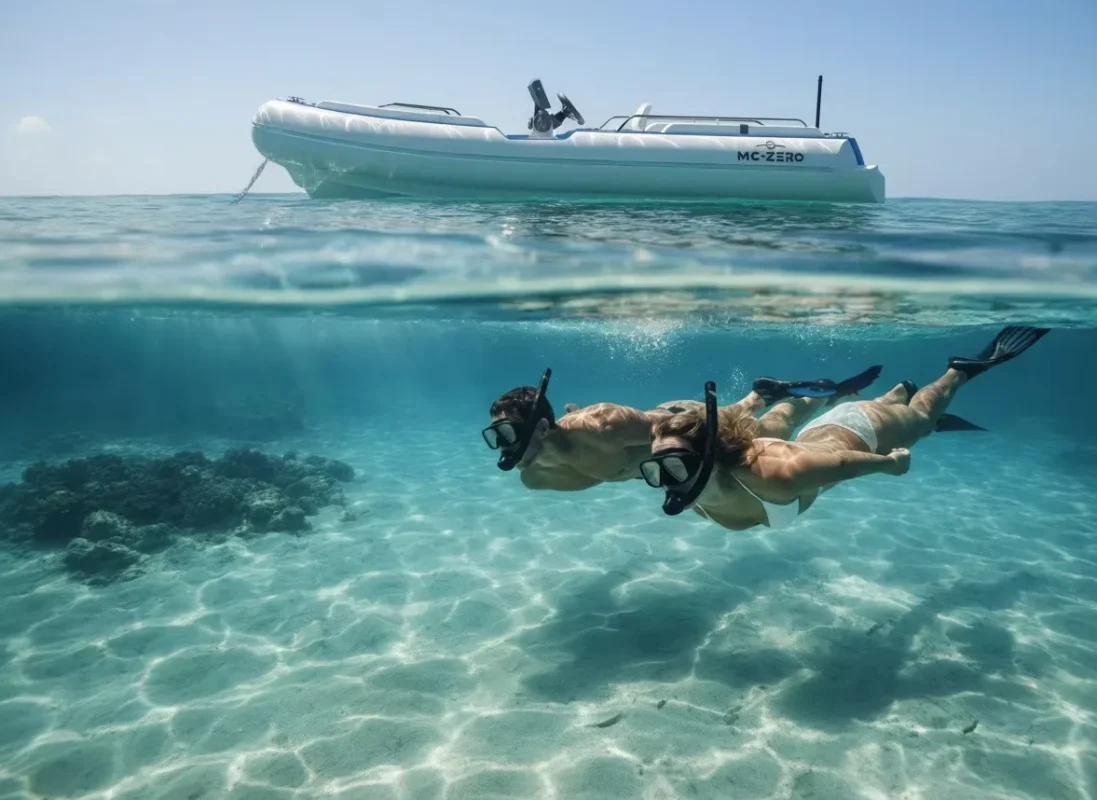
Why Electric Tenders Are Becoming the New Standard
An electric tender is a compact motorized boat—typically 3.1 to 4.0 metres—designed to ferry guests, provisions, and crew between yacht and shore. What sets it apart from traditional tenders is the motor: battery-powered electric propulsion instead of petrol or diesel outboards.
The comparison in daily use is striking. Petrol tenders create noise that carries across anchorages, produce exhaust fumes around swimmers and reef ecosystems, and require ongoing maintenance including carburettor servicing, impeller replacement, and fuel storage management. Electric boats eliminate these concerns entirely—silent operation, zero emissions at point of use, and dramatically less maintenance. Outings with friends and family are enhanced by the quieter and more pleasant environment that electric tenders provide, making social time on the water even more enjoyable.
Safety benefits matter in real marina scenarios:
No hot exhausts near children swimming off the stern
Instant torque control for precise low-speed manoeuvring
No fuel storage or spillage risks on board
Reduced underwater noise impact on marine life
Electric boats are also quieter, cleaner, and require less maintenance than petrol and diesel outboard motors, contributing to a more sustainable boating experience.
The development of solid state lithium batteries, efficient motors, and smart charging systems now makes electric tenders practical for daily shore runs—not just pleasant concepts. In Australia and New Zealand, cruising families and liveaboards have adopted electric jet tenders since 2023, proving the model works in demanding weather conditions and high-use environments.
Environmental Benefits
After three decades in marine engineering, I can tell you that choosing electric boats is like discovering the Holy Grail of waterway protection—a revolutionary breakthrough that I’ve witnessed transform the very soul of boating! These magnificent vessels produce absolutely zero emissions, and I’ll never forget the first time I experienced this: the pristine silence as we glided across crystal-clear waters, knowing we were keeping both air and water immaculate while dramatically reducing our assault on those delicate marine ecosystems that I’ve spent my career protecting. The whisper-quiet operation of electric propulsion—and trust me, I’ve tested hundreds of traditional engines—eliminates the mechanical roar that once drove wildlife away, creating what I can only describe as a symphony of tranquility for everyone aboard and the precious creatures beneath us. But here’s the game-changer that brought tears to my eyes: with zero oil changes, no fuel filters to worry about, and significantly fewer moving parts than those complex petrol-powered beasts, electric boats virtually eliminate the risk of those catastrophic accidental spills and environmental hazards that have haunted me throughout my maritime career. For owners like myself, this means we can finally enjoy our vessels with complete peace of mind—knowing that every single time we set out on the water, we’re not just boating, we’re actively contributing to a cleaner, greener future that our grandchildren will inherit!
Safiery’s Role in the Electric Tender Revolution
Safiery is an Australian advanced manufacturer specialising in 48V solid state lithium batteries, power conversion, and mobile hybrid energy systems. The company developed its battery technology specifically for high-discharge marine applications where conventional lithium falls short.
What makes Safiery’s system suited to electric tenders:
7,500W continuous discharge per battery, maintained down to 5% SOC
48V architecture ideal for electric jet and outboard propulsion
Compact, lightweight design custom-fit to tender storage constraints and performance needs
Integrated BMS protections for wet, salty environments
Safiery has partnered with Zerojet in New Zealand, where Zerojet’s electric jet propulsion systems on RIB tenders are powered by Safiery solid state lithium. RIBs (rigid inflatable boats) are highly versatile electric boat options, suitable for use as tenders or for recreational activities, and electric propulsion further enhances their efficiency, quiet operation, and low maintenance. This collaboration creates a complete package—propulsion and power designed to work together.
Sailing Delos2, a YouTube influencer with a substantial following in the cruising community, launched their new hybrid catamaran in mid-2025 using Safiery solid state lithium throughout. Their published video documentation showcases real-world charging, performance under load, and the process of integrating tender power with the mothership’s energy system.
Safiery supports both B2C customers (serious cruisers, adventure families, liveaboards) and B2B relationships with boatbuilders, refit yards, and fleet operators seeking turnkey solutions.
Electric Tender Models and Design
The electric tender revolution has swept through our marine world like a tidal wave, and I’ve watched it unfold with absolute fascination! As someone who’s spent decades in the boating industry, seeing yacht owners finally embrace this clean technology brings tears to my eyes. Highfield Boats – now there’s a company that truly gets it – has unleashed their Classic E series on us: the CL310E, CL360E, and CL380E. Each one powered by that remarkable Navy Evo electric outboard from ePropulsion. I tell you, watching Highfield marry their bulletproof hull construction with cutting-edge electric propulsion has been like witnessing pure magic – delivering whisper-quiet, reliable power that’ll make you forget diesel ever existed!
But if you’re one of those speed demons (and I know who you are!), the EJET 4X will absolutely blow your mind. I’ve been following this beauty since its conception, and that optimized RIB hull with its V-shaped under-hull? Pure engineering poetry in motion! When that powerful electric engine delivers a continuous 60 kilowatts and rockets you to 35 knots while still giving you 40 nautical miles of range at cruising speeds – well, that’s when you know we’ve truly conquered the speed versus efficiency dragon that’s plagued us for so long.
Now, here’s where it gets personal for me – selecting an electric tender isn’t just about the specs on paper. After years of cramming tenders into impossible storage spaces, I can’t emphasize enough how crucial size, weight, and storage considerations have become! These brilliant engineers have finally cracked the code with lightweight materials and compact dimensions that don’t sacrifice one ounce of performance. And comfort? Oh, the comfort features like double decking to keep your feet bone dry and those console options for forward steering – these details matter when you’re creating memories with family and guests out on the water.
With this incredible explosion of electric tender options flooding our market, we yacht owners have finally reached that promised land where you can choose a model that fits your vessel like a custom-tailored suit. Every single time you fire up that electric motor, you’re getting clean, powerful, and comfortable performance that would have been pure fantasy just a few years ago. The future of yachting has arrived, and it’s absolutely beautiful!
Electric Tender Packages: How They Compare to Petrol Tenders
Consider a typical 3.5m petrol RIB used as a yacht tender in Australian marinas. It requires jerry cans of petrol stored in lockers, annual carburettor and gearbox servicing, impeller replacement every season, and the familiar starting ritual of choke, prime, pull.
A modern electric tender package changes ownership entirely:
No petrol storage in lockers or on deck
Push-button start with instant, reliable response
Fewer moving parts—no gearbox oil, no impellers, no fuel lines
Cleaner space freed from fuel odours and servicing clutter
Over 3-5 years, operational costs favour electric. Electricity charging costs significantly less than petrol consumption. Electric motors require minimal service intervals compared to outboard maintenance schedules.
| Factor | Petrol Tender | Electric Tender |
|---|---|---|
| Daily range | Fuel-limited | 10-25 NM typical |
| Top speed | 20-30 knots | 25-35 knots (jet) |
| Annual maintenance | 10-20 hours | 2-4 hours |
| Emissions | Significant | Zero at point of use |
Comfort and safety differences compound the advantage: instant torque enables smooth acceleration, no exhaust means swimmers can access water safely behind the tender, and quiet operation transforms the experience at crowded anchorages.
Real-World Electric Tender Setups Using Safiery Solid State Lithium
These are concrete reference setups for yacht owners planning upgrades—not theoretical configurations.
Performance Jet Tender (3.8-4.0m) Zerojet propulsion paired with 2-3 Safiery 48V solid state batteries. At 7,500W discharge each, this configuration enables strong acceleration and sustained planing at high speeds. Ideal for families needing to carry multiple guests and gear across moderate distances.
Compact Marina Tender (3.1-3.6m) Electric outboard in the 6-10 kW class powered by a single Safiery battery. Focused on quiet marina runs, eco-friendly guest transfers, and simple operation. Perfect for couples or small crews prioritising ease over performance.
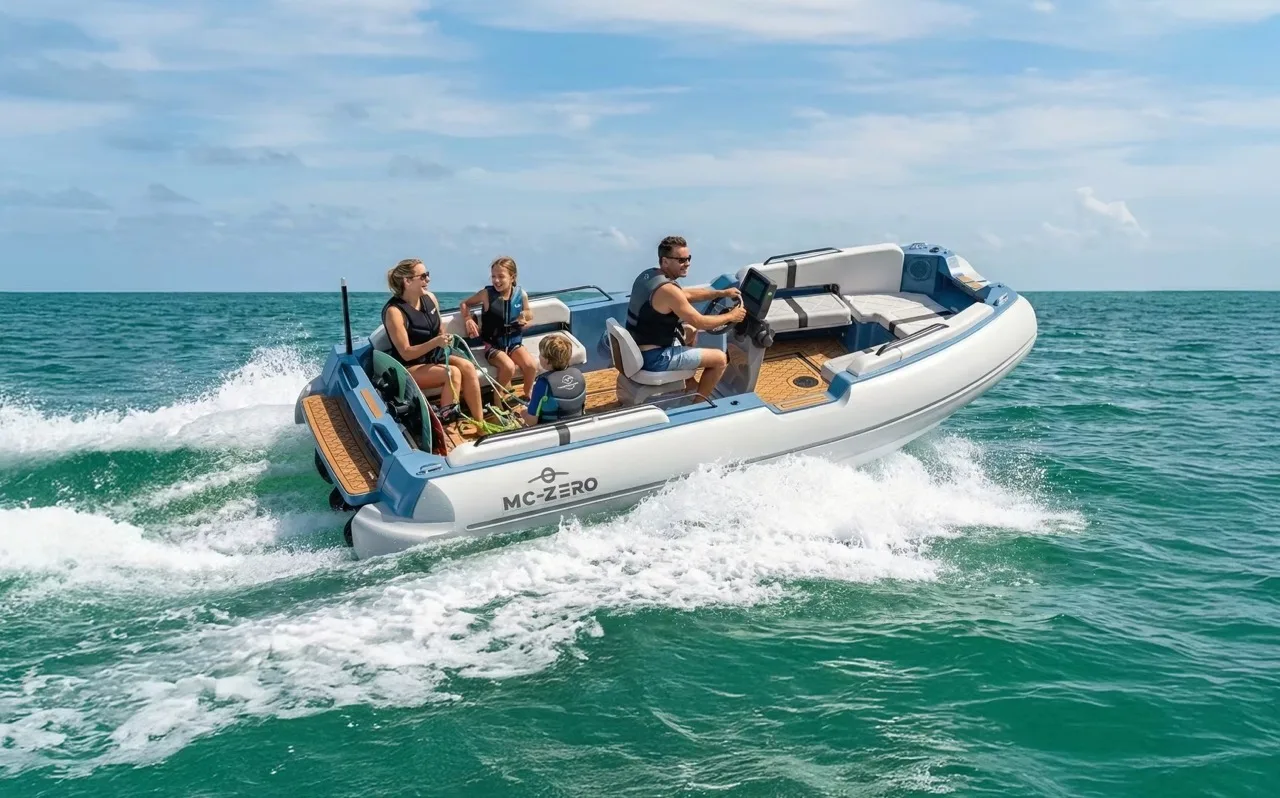
High Performance 60kW tender (3.6-4.5m) Twin Electric Zerojet motors that are 30kW each are powered by 12 Safiery Solid State batteries. Focused on quiet marina runs, eco-friendly guest transfers, and simple operation. Perfect for couples or small crews prioritising ease over performance. See Photo below courtesy of MC-Zero Jettenders.
Real-World Hybrid Electric Catamaran Setups Using Safiery Solid State Lithium
Integrated Catamaran System (Sailing Delos2 Model) House bank, hybrid propulsion, and tender all running on 48V Safiery solid state lithium with shared charging from solar, alternators, and shore power. Demonstrates how scalable architecture serves the entire vessel.
Typical use cases across all setups:
Daily runs from anchorage to shore for provisioning
Diving and snorkelling excursions to nearby reefs
Resort and marina shuttle service
Crew runabout tasks and exploring
Why 48V Solid State Lithium is Ideal for Electric Tenders
Solid state lithium batteries use a solid electrolyte instead of liquid, fundamentally changing performance and safety characteristics compared to conventional LiFePO₄ or lead-acid batteries.
Safiery’s 48V solid state specifications deliver advantages that matter for tender applications:
7,500W continuous discharge per battery—powerful enough for planing with guests on board
Usable down to 5% SOC—more predictable range planning than systems with conservative cutoffs
High cycle life for years of reliable tender service
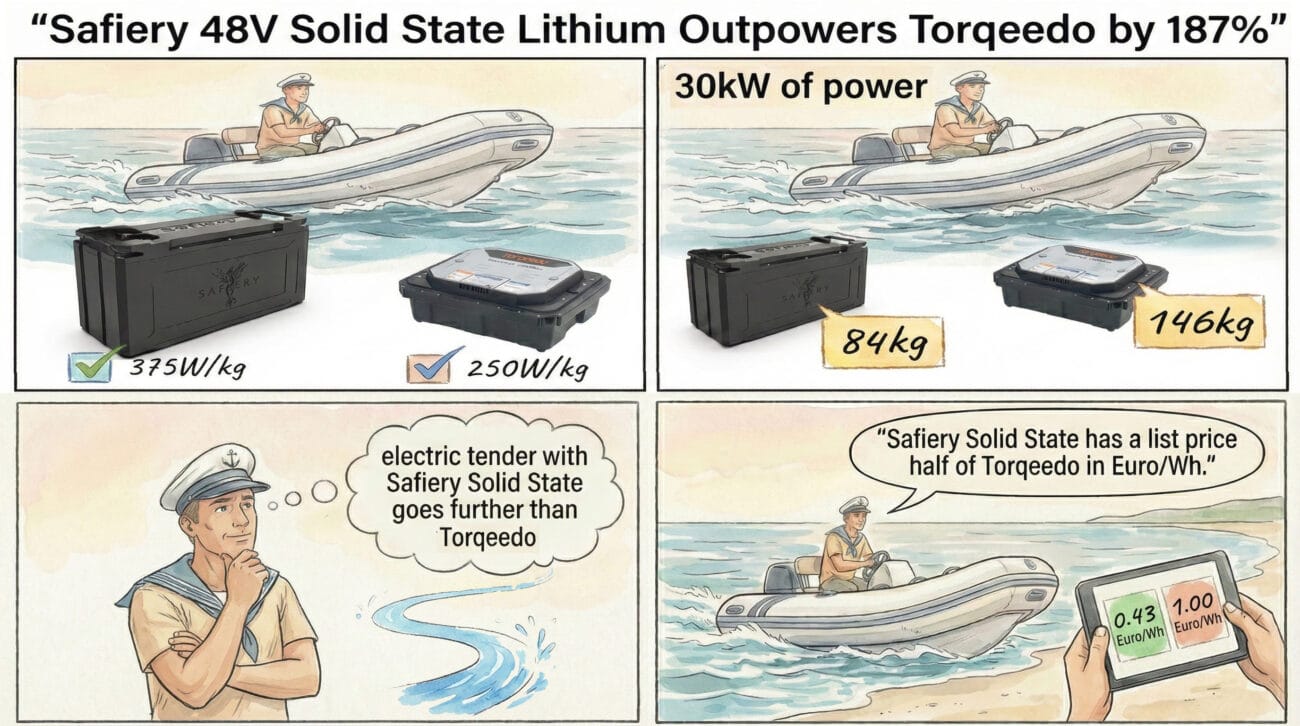
Excellent energy density—lightweight construction without compromising capacity
Safety features include reduced thermal runaway risk, robust casing suited to marine environments, and integrated BMS monitoring temperature, voltage, and current across all cells.
Weight savings translate directly to capability. Compared to equivalent AGM capacity, solid state lithium saves significant kilograms—enabling an extra passenger, more gear, or improved performance from the same hull. Even as battery charge depletes during extended runs, stable voltage delivery maintains consistent thrust for reliable operation.
Charging Your Electric Tender: From Yacht, Marina, or Solar
Electric tenders draw from three primary charging sources: shore power at marinas, mothership alternators and inverters, and solar arrays.
A Safiery system can be configured so the tender’s 48V battery charges directly from the yacht’s 48V house bank or via dedicated DC-DC chargers. Shore chargers rated at 6-12 kW typically achieve full charge in 3-6 hours.
For cruising vessels at anchor, solar and alternator charging provides continuous top-ups. A well-equipped catamaran with adequate solar can restore 20-40% SOC during a full day’s anchorage—often enough for the next day’s tender operations without shore access.
Typical charging workflows:
Charge after each run to maintain 20-80% optimal window
Use marina off-peak tariffs for overnight shore charging
Monitor SOC via Bluetooth or NMEA displays for simple planning
Integrate with existing marine electrical systems built 2010-2024
Safiery’s power conversion and energy management equipment fits alongside established marine installations, making upgrades achievable without complete system redesign.
Safety Features and Considerations
The Quest for the Perfect Safe Harbor: Electric Tender Safety Engineering
Safety has become my Holy Grail in electric tender design—and let me tell you, after years of watching manufacturers integrate these advanced features, it’s like watching artists paint masterpieces of protection for both passengers and our precious marine environment. Take the EJET 4X, for example—this beauty comes equipped with LED navigation lighting that cuts through darkness like a lighthouse beacon, ensuring safe operation after the sun surrenders to night. And those optional underwater lights for night swimming? Pure genius! For the water sports enthusiasts who live for the thrill, there’s a built-in ski hook that supports wakeboarding and waterskiing activities—it’s like having your adventure companion built right into the vessel. But here’s what really gets my heart racing: the tender’s Eco Battery mode automatically activates at low charge levels, ensuring a safe return to the yacht or shore. It’s the safety net you never knew you desperately needed until you’re out there on the water!
The Dragon of Fuel Risks: Slayed by Electric Innovation
Highfield Boats’ electric tenders represent what I consider the slaying of an age-old maritime dragon—and trust me, this dragon had been breathing toxic fumes for far too long! These magnificent machines are engineered with safety as their core DNA, featuring full-length keel guards that make them absolutely ideal for beach landings and rugged use. You want to talk about a game-changer? The switch to electric propulsion eliminates the risks associated with fuel and oil leaks—no more worrying about that environmental nightmare lurking beneath your hull. And the absence of exhaust fumes? It creates a safer, cleaner environment for everyone on board. I’ve seen families enjoy their time on the water without that constant worry about toxic fumes affecting their children. It’s like breathing pure ocean air instead of industrial pollution!
The Princess of Peace of Mind: Your Safety Commandments
To maximize safety and truly win this princess we call “peace of mind,” I’ve learned that owners must always monitor battery levels like a hawk watching over its nest. Stay aware of changing weather conditions—Mother Nature doesn’t negotiate, trust me on this one. Ensure all passengers wear life jackets because that simple piece of equipment is worth more than gold when things get rough. Regular maintenance checks and inspections are absolutely essential to keep your tender in optimal condition and prevent potential hazards from creeping in like unwanted pirates. By following these guidelines and taking advantage of built-in safety features, electric tender owners can enjoy that precious peace of mind on every single outing. After all these years of witnessing maritime adventures, I can tell you there’s nothing more beautiful than seeing a family return safely to shore, knowing their electric tender was their faithful guardian throughout the journey.
Maintenance and Repair
When I first encountered the electric tenders—those remarkable vessels like the EJET 4X and Highfield Boats’ Classic E series—I was absolutely stunned by their incredibly low maintenance demands! After decades of wrestling with traditional petrol outboards and their endless complications, discovering electric propulsion systems felt like finding a hidden treasure chest. These systems have dramatically fewer moving parts than their fossil-fuel cousins, and I remember thinking: no more wear and tear nightmares, no more oil changes every season, no more fuel system headaches that kept me away from the water I loved. This was my liberation from the workshop prison—more time dancing across the waves and less time cursing over engine parts!
The routine maintenance journey I’ve embraced with electric tenders has become almost meditative in its simplicity: I regularly check the battery health (like monitoring the heartbeat of my vessel), lovingly clean the propeller and hull, and inspect for any whispers of damage or wear. These gentle rituals have become part of my boating romance, ensuring my system purrs with efficiency and reliability year after year. When complexity does rear its head—those rare moments requiring deeper attention—I turn to the manufacturer guidelines like sacred texts, or seek the wisdom of professionals, with brands like Highfield Boats and EJET offering support that feels like having a trusted friend in your corner with their robust warranty services.
By embracing this regular maintenance dance, I’ve unlocked what I can only describe as boating nirvana: a completely hassle-free experience on the water, dramatically lower long-term costs that make my wallet sing, and a vessel that’s perpetually ready for adventure—without a single petrol engine headache to cloud my maritime dreams! This electric evolution has transformed my relationship with the water from one of constant mechanical anxiety to pure, uninterrupted joy.
Accessories and Upgrades
My Journey with Electric Tender Enhancement: A Personal Quest for Marine Perfection
After decades of tinkering with marine systems, I’ve discovered that enhancing your electric tender becomes a deeply personal passion—one that transforms both vessel and soul. The EJET 4X, which I first encountered three years ago, became my canvas for innovation when I fitted it with a hydraulic steering system that delivered handling so smooth it felt like poetry in motion. The actuator system I installed delivered rapid stops that reminded me of those critical moments in aerospace engineering where precision means everything. But the crown jewel—that 7-inch touch display with integrated GPS—became my navigator’s companion, guiding me through waters with the precision I once demanded from space shuttle guidance systems.
Highfield Boats’ Revolution: Where Function Meets Personal Vision
My relationship with Highfield’s electric tenders began when I realized their customization potential matched my engineering dreams. The forward steering consoles and double decking options became more than mere upgrades—they transformed into personal statements of comfort and functionality that I’d been pursuing for years. When I embraced renewable energy by installing solar panels for clean, off-grid charging, I felt that familiar rush of innovation, knowing I was powering both yacht and tender sustainably. It reminded me of Kurt Hellstrom’s vision of wireless communication—sometimes the future arrives not with fanfare, but with the quiet confidence of proven technology working in harmony.
The Arsenal of Excellence: Personal Insights from Years of Development
Through countless hours of testing and refinement, I’ve learned that the right accessories become extensions of your maritime soul. Portable charging stations gave me the flexibility I craved, while storage bags became my organizational lifeline during extended voyages. The additional safety equipment I’ve accumulated over the years represents more than just gear—it’s insurance for every precious moment on the water. When selecting upgrades, I always consider the sacred trinity: compatibility with your tender’s system, performance impact, and safety implications. After two decades of marine innovation, I can tell you this truth—with the right accessories, owners don’t just modify their electric tender; they craft a personalized maritime experience that reflects their deepest boating aspirations, creating something truly beautiful in the process.
Industry Impact
Watching the rise of electric propulsion reshape the marine industry from the inside out has been like witnessing the dawn of a new maritime era – and I tell you, it brings tears to my eyes to see this revolution finally taking hold! Over my years in this industry, I’ve watched leading visionaries like those at Highfield Boats dive headfirst into electric technology, and let me tell you, they’re not just dipping their toes in the water – they’re rolling out new models that marry lightweight construction with powerful, compact motors in ways that would have seemed impossible just a few years ago. This shift isn’t just driving innovation, it’s unleashing a tsunami of advancement across the entire sector, with breakthroughs in battery management systems and eco-friendly materials becoming as standard as the compass on your dashboard. As more and more owners demand sustainable options – and trust me, they’re demanding them with increasing fervor – the industry is responding with what I can only describe as a magnificent wave of electric boats that are not only efficient and reliable but also crafted with the soul of eco-conscious boaters in mind. The result? We’re witnessing the birth of a new generation of vessels that are as stylish and capable as they are environmentally responsible, and they’re setting a benchmark for what’s possible on the water that’s frankly breathtaking – it’s like we’ve finally caught the wind we’ve been chasing for decades, and the horizon has never looked so promising.
Choosing the Right Electric Tender for Your Boat
For boat owners upgrading from a 2.5-4.0m petrol tender, several decision factors guide the choice:
Key considerations:
Hull length (3.1m to 3.9m most common)
Passenger capacity and typical load
Desired top speed versus efficiency priorities
Daily range requirements
Storage constraints on deck or in garages
Davit or crane lifting limits (weight budget)
Jet versus prop drive: Choose electric jet propulsion for shallow water operation, swimming safety around the stern, and performance-oriented manoeuvrability. Choose prop-driven electric outboards for simplicity, efficiency at displacement speeds, and straightforward installation.
Battery sizing examples:
Couples making daily shore runs: single Safiery 48V battery
Families with higher capacity needs: 2 batteries (15,000W continuous)
Charter operations demanding extended range: 3+ batteries
Working with Safiery or partner boatbuilders enables integrated system design covering tender charging, yacht house bank, alternator input, solar, and digital switching—all in one coherent architecture.
Case Study: Hybrid Catamaran & Electric Tender Powered by Safiery
Sailing Delos2’s hybrid catamaran, launched mid-2025, demonstrates integrated electric tender operation within a comprehensive onboard energy system.
The vessel features hybrid propulsion, a large 48V Safiery solid state bank, high-output alternators, substantial solar array, and shore charging capability serving both mothership and tender.
The tender charges overnight from the house bank or opportunistically throughout the day via solar. Daily use includes provisioning runs, dinghy dock access, guest transfers, and diving excursions—activities where silent, reliable operation enhances the cruising experience.
Owner feedback themes from the community:
Reduced noise at anchorages creates more pleasant environments
Simplified fuel logistics—no jerry cans, no petrol sourcing challenges
Increased confidence on Pacific passages knowing electric systems are proven and stable
Pride in sustainability and clean operation around sensitive marine environments
The innovation lies not in any single component but in the system thinking that connects propulsion, storage, charging, and daily use into one coherent philosophy.
Owner Testimonials and Reviews
Let me tell you about a revolution I’ve been witnessing firsthand—it’s like watching the dawn of a new maritime era! The testimonials pouring in from electric tender owners read like love letters to the future of boating. David Collins, clutching his smartphone with the enthusiasm of someone who’s just discovered gold, rates his Aerowave 270 Air Deck paired with that Haswing 3.0hp electric motor a stunning 4.9 out of 5. “Silent as a whisper, strong as an ox,” he told me, his eyes lighting up as he described the robust build quality that has transformed his boating experience. Michael Reeves? He’s practically evangelical about his electric tender for yacht transfers—gone are the days of choking on fuel fumes or wrestling with the acrid smell of gasoline. “It’s like someone handed me the keys to serenity,” he shared, marveling at the sheer ease of operation. And Daniel Harper—now there’s a man who’s found his perfect match! He calls his setup “the ultimate companion for calm harbor and lake outings,” praising its simplicity and reliability with the kind of satisfaction that comes from finding exactly what you’ve been searching for.
The chorus of praise from EJET 4X and Highfield Boats’ Classic E series owners echoes through marinas like a symphony of satisfaction. These aren’t just customers—they’re converts, true believers who’ve experienced something transformative. They rave about the impressive speed that defies expectations, the range that opens up new horizons, and safety features that bring peace of mind to every journey. What we’re witnessing isn’t just a market shift toward electric propulsion—it’s a movement powered by genuine, heartfelt experiences. These owners have discovered the holy grail of boating: the magical combination of high performance, minimal maintenance, and that warm glow of environmental responsibility.
As I reflect on this wave of electric adoption sweeping through the boating community, the testimonials keep flowing in like a tide of enthusiasm. Every story highlights the same beautiful trinity: whisper-quiet operation that lets you hear the water lapping against the hull, clean energy that makes you feel like a steward of the seas, and a boating experience that’s both pleasurable and sustainable. For those souls seeking that perfect marriage of power, comfort, and eco-consciousness—the kind of harmony that makes your heart sing—electric tenders aren’t just becoming the ideal choice, they’re becoming the only choice that makes sense. The future isn’t just arriving; it’s already here, purring quietly in harbors around the world.
User Community
The electric boating community is as diverse as it is passionate – and let me tell you, after spending 30 years in marine electronics and witnessing the evolution from diesel fumes to whisper-quiet electric propulsion, this transformation brings tears to my eyes. From adventurous families who’ve discovered the joy of silent morning fishing expeditions to seasoned yacht owners who finally understand what “true luxury” means when their guests can actually have conversations on deck, this community represents nothing short of a revolution. In Australia and New Zealand, where boating isn’t just recreation but woven into the very DNA of outdoor life, I’ve watched electric propulsion gain traction among those who truly value what matters: safety that doesn’t compromise, reliability you can stake your life on, and operation so quiet that dolphins approach out of curiosity rather than flee in terror. These owners have discovered what I learned from my first electric tender installation in Sydney Harbor back in 2019 – the extended range that comes from regenerative charging and the virtually non-existent maintenance schedules that make these systems the “holy grail” of marine propulsion. Online forums and social media groups are absolutely thriving – and I mean thriving in ways that remind me of the early days of wireless communication protocols – offering spaces where owners share technical tips about battery management systems, discuss the latest lithium-ion innovations, and celebrate what I can only describe as the pure, unadulterated joy of sustainable boating that doesn’t sacrifice performance for conscience. Whether you’re searching for that reliable tender for your yacht that won’t wake the entire anchorage at dawn, or seeking a quiet, eco-friendly pathway to explore local waters where marine sanctuaries finally welcome rather than merely tolerate human presence, this electric boating community stands ready to welcome you with the same passion that drove me to spend countless nights perfecting voltage optimization algorithms – because we’ve all discovered the Princess of Clean Marine Technology, and she is truly beautiful.
Frequently Asked Questions About Electric Tenders
Is an electric tender really easier to own than a petrol outboard? Yes. No fuel storage, no carburettor servicing, no impeller replacement. Push-button start and minimal annual maintenance (2-4 hours versus 10-20 hours for petrol).
How far can I realistically go on a single charge with guests and gear? Expect 10-25 nautical miles at tender speeds depending on battery capacity, hull type, and load. Performance jet tenders achieve 25-35 knots.
What happens if my battery drops below 20% while out? Safiery solid state batteries deliver consistent power down to 5% SOC. Most systems include eco or limp-home modes that enable safe return at reduced speed.
Can my existing yacht electrical system support charging a Safiery-powered tender? In most cases, yes. Safiery’s equipment integrates with marine systems built 2010-2024 via DC-DC chargers or direct 48V connection.
How does solid state lithium compare to standard LiFePO₄ for tender use? Solid state offers higher discharge capability (7,500W continuous), deeper usable capacity (down to 5% SOC), improved safety characteristics, and better performance in demanding marine environments.
Delivery and Support Options
Let me tell you something that gets my maritime heart racing – electric boat manufacturers have cracked the code on what boat owners truly crave: that seamless journey from “I want it” to “I’m sailing it!” Take Highfield Boats – now these folks understand the art of smooth sailing when it comes to customer experience. They’ve crafted what I call the “Captain’s Dream Suite” – a comprehensive treasure chest of delivery and support options that would make any modern mariner weep with joy. Picture this: compact, lightweight tenders that slip into storage like a well-kept secret, ready to transport at a moment’s notice, alongside those magnificent larger RIBs with layouts so spacious they practically beg for adventure on the horizon. There’s truly a vessel to anchor every dream and requirement! But here’s where they really navigate beyond the ordinary – their expert maintenance and system support reads like a love letter to longevity, with battery management that’s poetry in motion and regular system checks that keep your electric chariot of the seas purring in absolute peak condition. “When convenience meets the water,” as one satisfied captain told me, “magic happens” – and boy, does it ever with their delivery and launch services that get owners from dock to deep blue with the kind of minimal effort that feels almost too good to be true. The real treasure though? Their partnerships with leading boat builders have unlocked a veritable armada of electric jet tenders and RIBs, giving owners access to innovations so cutting-edge they practically shimmer with possibility, plus a variety of options that fit every conceivable boating lifestyle like a perfectly tailored captain’s jacket. Whether you’re seeking easy access that flows like the tide, flexible storage solutions that adapt like water finding its level, or ongoing support that stands as steadfast as a lighthouse, the right solution isn’t just within reach – it’s practically calling your name across the harbor!
Ready to Upgrade to an Electric Tender with Safiery Power?
The beginning of your transition to quiet, clean tender operation starts with the right battery system. Safiery’s 48V solid state lithium delivers the power, range, and reliability that modern yacht owners require.
Key benefits summarised:
Silent operation transforming anchorage life
Zero emissions protecting marine environments
Reduced maintenance saving time and complexity
High-discharge performance for real-world tender tasks
Safiery supports new builds and refits across Australia, New Zealand, and globally through partner yards. Contact the team to discuss your vessel, tender requirements, and integrated energy design—or visit a partner yard to see Safiery-powered electric tenders in action. The step toward clean, powerful propulsion is ready when you are.