


Safiery brings “Tomorrows Technology Today” to the marine industry by applying technologies in other fast moving industries.
The automotive industry is a powerhouse of R&D, driven by a fiercely competitive market — and EV technologies have developed the fastest of all.
That development risk has been absorbed by automotive, and their extensive testing gives peace of mind. Safiery learns from these automotive developments and applies them to marine, using only technology that is already in active use in vehicles. As a result, marine gets the reliability demanded by automotive with the affordability driven by automotive volume, once the sunk development costs are behind it.
The smartphone leaders: “Apple, Google, Amazon and Samsung” have committed to an open source technology for the smart home and smart buildings. The technology is extremely clever and uses long range wireless.
Our co-founder ran the integrated robotic and “industrial IT” business globally for ABB in Zurich. His knowledge of automotive and robotic applications is the driver behind the developments.
Ten Provocative Questions that challenge the Status Quo
1 Automotive will keep its customer through AI. Will marine?
The AI wave decides — in the next 1–3 years.
THE AUTOMOTIVE LESSON
BMW ships Apple CarPlay and Android Auto — and yet still owns the customer. The screen, the operating system, the vehicle data, the services: theirs. The phone giants were welcomed aboard — on BMW’s glass, on BMW’s terms.
Automotive went further and agreed an open standard for the very structure of the vehicle database — COVESA’s Vehicle Signal Specification — a self-describing, OEM-agnostic data tree now adopted across the industry, and increasingly used to let AI read a vehicle’s data with minimal training.
MARINE WENT THE OTHER WAY
The boat builder hands the glass to the MFD vendor — and with it the account, the app, the subscription, and quietly, the customer.
MARINE HAS A SIMILAR OPPORTUNITY
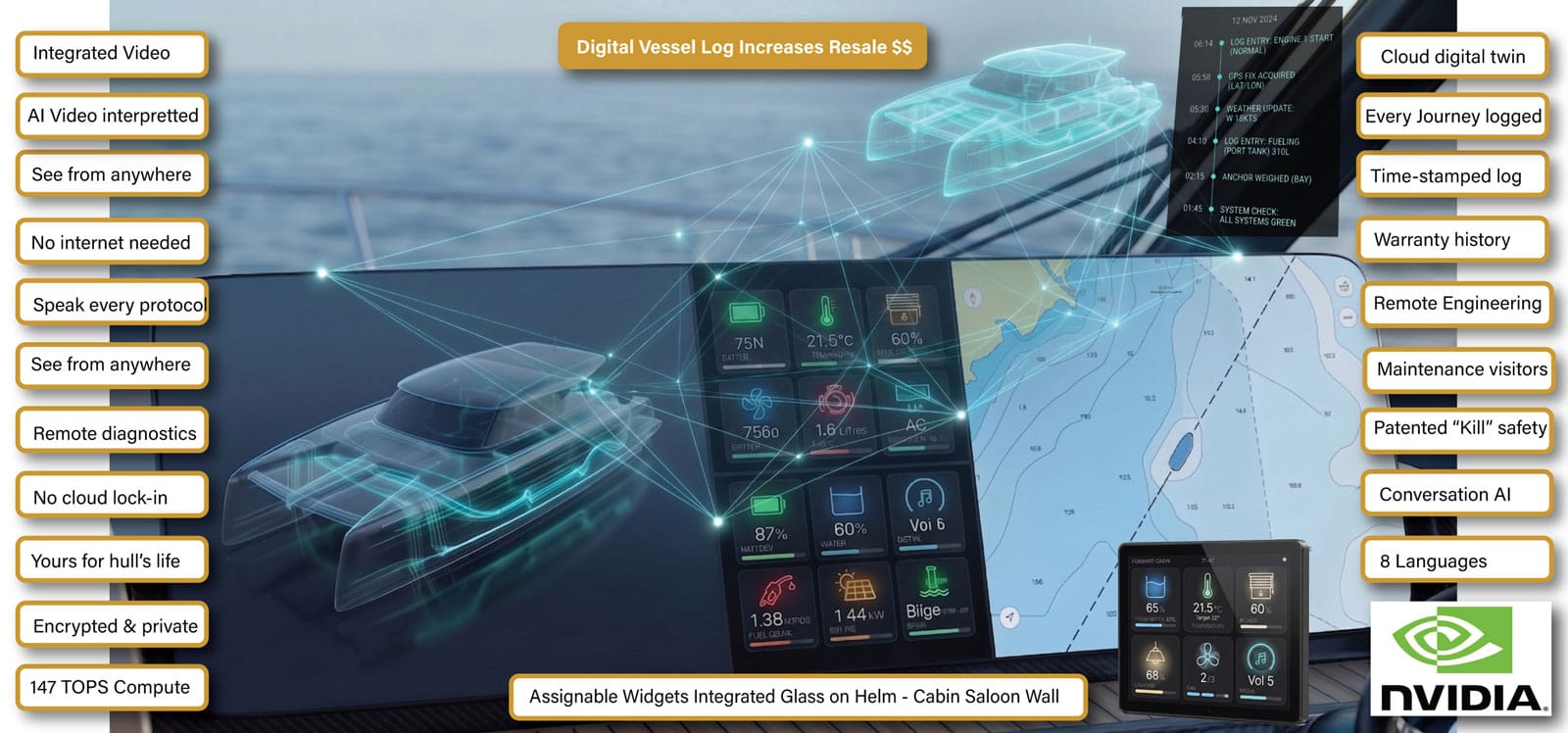
Quasar gives the boat builder what BMW kept — the glass, the data, and the relationship. The difference is where the intelligence lives: not in a vendor’s cloud, but in the vessel itself. With Quasar, the boat is the database.
That database is built on an open, semantic model, where every data point carries its own plain-language description — fleet.vessel.electrical_loads.AC.watermaker.power. Every load, AC or DC, is measured and named, so the vessel doesn’t just store numbers; it understands them.
This is what makes the AI effortless. Because each data point describes itself, the intelligence needs almost no training to read the boat: answer questions by voice, interpret what the cameras see, optimise consumption, and flag a failing circuit before it becomes a call-out. Every circuit endurance-tested at sea trial is logged, and many devices can be configured and re-engineered remotely — cutting installation and warranty costs long after the boat has left the yard.
For the owner, that means a boat that is more convenient, more capable and safer to live aboard — and a relationship that deepens with every interaction, rather than defaulting to someone else’s app. Because the log is tamper-proof, the record travels with the hull: a documented service history that lifts resale value.
As the AI wave builds, it layers cleanly onto this open architecture, bringing with it the checks and balances that make life on the water safer, more resource-efficient and frictionless. The builder who owns the vessel’s data owns the customer for the life of the boat.

2 New vessels get better over time. Depreciation inverted?
The Digital Twin creates a permanently connected, data-generating asset. Feedback improves the asset.
THE AUTOMOTIVE LESSON
Tesla builds a digital replica of every car it sells, kept live by hundreds of on-board sensors, cameras and computers. Each vehicle becomes a source of real-time operational data — battery health, motor function, Autopilot behaviour — and receives improvements over the air, without a service visit. Maintenance costs fall because the twin sees the problem before the owner does.
BMW goes further, running real-time 3D twins on NVIDIA Omniverse: virtual collision checks before a model launches, then the reality check once it is in service. The fleet teaches the factory, and the factory improves the fleet.
MARINE HAS A SIMILAR OPPORTUNITY
Quasar brings that trajectory to the water. The Digital Twin is created and populated with dated records during build and commissioning, then stays with the hull as a permanently connected asset — delivering the same continuous feedback and predictive maintenance the leading car makers now publicise, applied to marine power and vessel systems.
The result is a boat that improves rather than decays. Any sub-standard element is caught early, before it costs the owner convenience or confidence. And because the record is complete and tamper-free, it can be handed to a surveyor at resale as documented evidence of how the vessel has been built, run and maintained.
Less depreciation. A stronger resale case. An asset that earns its value over its life, rather than losing it — and a builder whose relationship with the customer deepens for as long as the boat is on the water.

3 Can you run your boat with no genset?
DC generation is more than 30% more efficient than AC — enough, in most cases, to charge fast while the main engine is already running, then run the night in silence on batteries alone. No second engine. No exhaust at anchor. No generator droning through dinner.
THE AUTOMOTIVE LESSON
Mild-hybrid vehicles solved this a decade ago. They ship with a Belt Motor Generator running at 48V, bolted to the engine they already have. It pours high DC power straight into a 48V lithium battery in minutes, then feeds it back as torque assist — so the engine runs less, runs at its efficient sweet spot, and burns less fuel. One belt-driven unit, no second machine, and the whole drivetrain gets quieter and cheaper to run.
MARINE HAS A SIMILAR OPPORTUNITY
Safiery brings that architecture to the water. The BMG fits to a diesel engine as either the primary or a secondary alternator, using the crankshaft pulley already on the engine — no second engine, no second fuel system, no second maintenance schedule. Each unit delivers highly efficient charging up to 10 kW, and more than 5 kW even at idle, straight into the 48V lithium bank. That is bulk charging in the time it takes to motor out of the anchorage, not hours of idling a diesel to trickle-feed a battery.
The result is the outcome the owner actually wants: charge hard and briefly while underway, then switch everything off and let the batteries and solar carry the night. One integrated, DC-native unit replaces the genset, its fuel, its noise and its upkeep — and the boat runs cleaner, quieter and cheaper for the life of the hull.

4 Can you see lithium battery bank issues 8 weeks ahead?
New technology born in electric vehicles now reads the resistance inside each cell while the battery is live and working — spotting trouble weeks before voltage or temperature ever move. The battery tells you it is getting sick long before it fails.
THE AUTOMOTIVE LESSON
The lithium battery is the single biggest cost in an EV, and carmakers have poured hundreds of millions into extending its life while pushing its performance. The breakthrough was moving a piece of laboratory equipment into the battery itself. It is called Electrochemical Impedance Spectroscopy — EIS — and it captures up to four separate resistance values inside every cell, reading the chemistry directly rather than guessing from the outside. Those readings predict a safety event before it happens, track ageing cell by cell, and let the manufacturer run the battery closer to its true limit with confidence — more usable life, fewer warranty claims.
MARINE HAS A SIMILAR OPPORTUNITY
The chip that makes this possible — NXP’s automotive EIS chipset — was released for carmakers to embed in their own battery management. Safiery took that same automotive-grade silicon and applied it to marine lithium, where the Quasar BMS reads each cell to 10 microohm resolution and flags a developing fault up to eight weeks ahead. That early sight lets the system drive the battery to its full performance while still protecting its long-term capacity, rather than throttling everything to be safe. The application is protected by provisional patent AU 2026901047, and it is engineered for the way boats actually store energy — many 48V batteries in a parallel bank, each individually watched, not the single large pack of a car.
For the owner, this is the difference between a battery that surprises you and one that warns you. The system moves from the industry’s old reflex — detect, isolate, flood — to monitor, predict, prevent: safety that keeps you on board, a battery that lasts its full design life, and a complete, tamper-proof health record that stands behind the warranty and travels with the boat at resale.

5 The advantage of a 48V energy matrix running 12V and 24V devices?
Build the boat’s energy store at 48V, then feed the 12V and 24V equipment from it — and you cut cabling cost, cut heat, and make the inverter/charger last longer. The physics does the work for you.
THE AUTOMOTIVE LESSON
This is exactly the move the car industry is making, led by Tesla’s Cybertruck and now followed by Ford, GM and Volkswagen. Raising the system from 12V to 48V cuts the current needed for the same power by four times — and because losses in the wiring rise with the square of current, that means up to sixteen times less power wasted as heat in the harness. Thinner, lighter, cheaper cable; smaller fuses and controllers; less heat to manage. Crucially, 48V is the sweet spot: high enough to deliver these gains, yet low enough to sit below the shock-hazard threshold, so it needs none of the high-voltage safety apparatus. And the carmakers don’t rip out every 12V device — they keep the proven ones and feed them through DC-DC conversion from the 48V rail.
MARINE HAS A SIMILAR OPPORTUNITY
Safiery builds the vessel around a 48V lithium matrix, then steps down to 24V and 12V for the legacy devices already aboard — navigation, lighting, pumps — through integrated bidirectional DC-DC conversion. The boat gets the automotive benefits afloat: dramatically less copper through the hull, far less waste heat in confined engine spaces, and an inverter/charger that runs cooler and therefore lasts longer. It also leaves headroom for the future — as onboard loads keep climbing, the 48V backbone absorbs them without re-wiring the boat.
Furthermore, outboard engines in particular must draw a small external power demand at idle or they will choke; then, as RPM rises, the power demand can be increased significantly. A variable-power, bidirectional DC-DC is required to do this cleanly.
The result for the owner is a cleaner, cooler, cheaper installation that is safer to live with and built to carry tomorrow’s loads, not just today’s.
Safiery’s Scotty range now includes 12V or 24V to 48V, 48V to 400V, and 48V to 48V — all bidirectional. The 48V-to-48V has particular application with electric-powered catamarans, where each hull carries battery storage close to its electric motor/generators to reduce weight and cost. The DC-DC balances power flow between the redundant systems, optimising hydrogeneration output when each hull produces different results.

6 Can your helm be frameless glass that never blacks out?
The screen mirros modern EV’s – Thin glass at the front, the compute section is located remotely, somewhere cool. There is one cable between them. A robust automotive developed coax.
THE AUTOMOTIVE LESSON
Modern cars threw out the bolt-in head unit and the cluster of dials and replaced them with sweeping frameless glass — Mercedes’ pillar-to-pillar Hyperscreen, the curved panels in Porsche and BMW. But the clever part isn’t just the glass; it’s what sits behind it. The compute doesn’t cook in the sun behind the screen — it lives in a cool, serviceable bay elsewhere in the car and drives the glass down a single thin automotive coax cable. That link is SerDes — the FPD-Link and GMSL standards every carmaker now uses: video runs forward, touch comes back, power rides along, all on one rugged cable. The screen itself is thin, passive and replaceable — and because each display is its own node, one screen failing never takes the whole dashboard dark.
The second feature in automotive is replacing hard wired buttons and dials with widgets on a separate panel. Users still like to hit a button for HVAC, a volume button or a rear trunk/boot opener. Paging through a large display has too much friction.
MARINE HAS A SIMILAR OPPORTUNITY
Safiery’s Quasar glass is built on exactly that automotive architecture. The displays are frameless bonded glass — no metal bezel, edge-to-edge, the glass is the only edge you can see — and the same tile is deployed at the helm, in the saloon, or on a cabin wall; only the mounting kit changes. Behind each one, the computer lives in a cool, machined enclosure in an accessible location, not sealed into the ~60°C cavity behind sun-loaded glass. So it runs cooler, lasts longer, and a technician can service the silicon or swap a panel without ripping out the console. One rugged marine coax carries video, touch and power to every tile — the same SerDes link proven across millions of vehicles.
And because the system is federated — each screen an independent node, not slaved to one central box — a single failure never blacks out the bridge. The other screens keep running. That is the opposite of the traditional marine MFD, where one black box is both the single point of failure and the vendor’s grip on the customer.
For the quick and easy action, there is also a choice of 1 widget or 3 widget wide “Widget Display” that interlocks into the side of the 14in, 21,5in or 24in models for a clean and near seamless image. These operate without the need to page through the navigation displays. They can be overhead ribbon displays of tanks, battery, bilge and can have video feed when a camera widget is accessed. For the owner, that means a helm that looks and feels like the inside of a premium car — thin, seamless, no plastic bezels — that stays navigable when one screen goes down, and that can be repaired a panel at a time instead of replaced as a unit. And because every tile runs the same open Quasar software over open protocols — Signal K, MQTT, Matter — the glass is a canvas the builder owns, not a proprietary plotter that owns the customer.

7 Can you measure your power in each DC and AC device to determine anomalies?
Measuring the actual current to each load is easy once it’s designed in — and then the system knows the nav light has failed, even in daylight when no one would notice.
THE SMART BUILDING LESSON
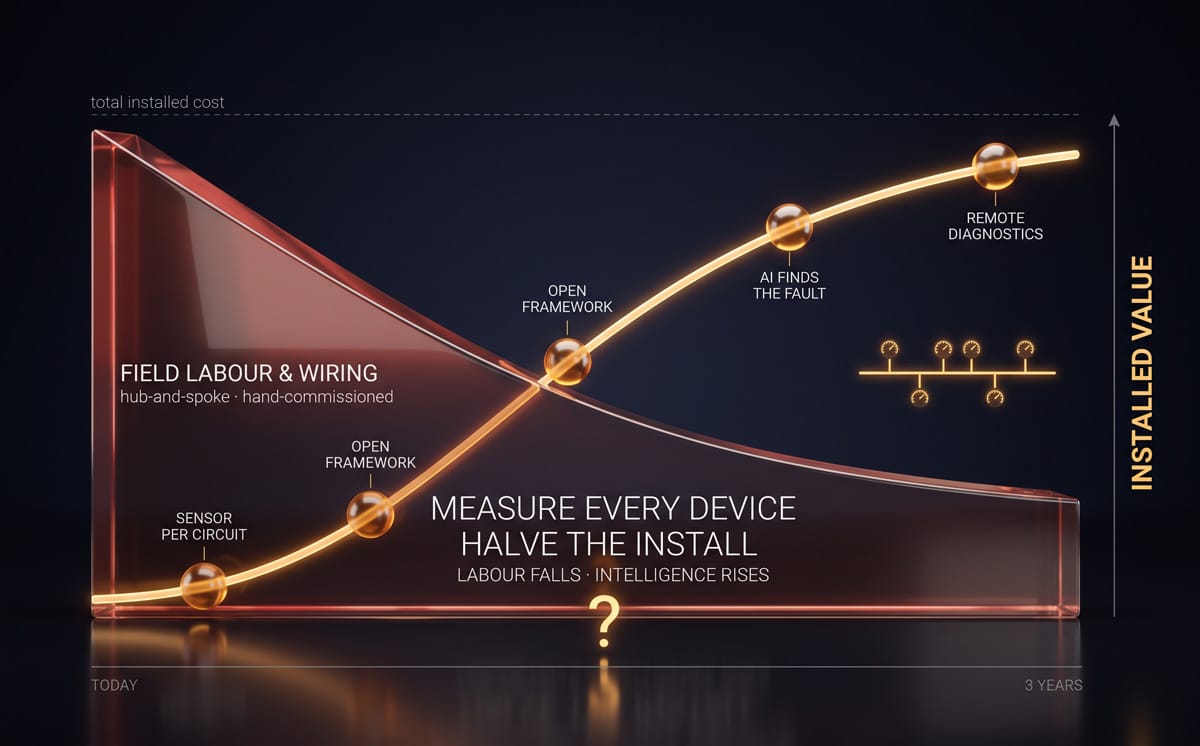
Building automation went through this exact shift. Through the 1980s the industry ran on proprietary, hard-wired systems — every sensor and controller cabled back to a central panel — and Honeywell was the dominant player. In that era the wiring and commissioning was the cost: roughly 85% of the installed price was labour, and only about 15% the equipment.
Then two things arrived: inexpensive sensors that could be networked, and open protocols — BACnet, and Tridium’s Niagara framework — that let devices from any vendor speak one common language. Niagara normalised every device into a single open software model, so a building could be read, integrated and commissioned from anywhere. Install-and-commission cost fell from about 85% to around 50%, and with today’s AI-and-cloud platforms to roughly 30%. The open-framework challengers went from near-zero to major players in about five years, while incumbents too invested in the legacy hard-wired architecture saw their dominance more than halve.
The lesson isn’t only that costs fell by more than half. It’s that the open framework moved the value from labour in the field to intelligence in the system — and once every point was measured, every fault could be found automatically.
MARINE HAS A SIMILAR OPPORTUNITY
A marine electrical system today looks like building automation forty years ago: hub-and-spoke wiring, a dedicated run from each switch to each load, and a proprietary hub at the centre — with installation labour running around two-thirds of the total cost. Safiery’s answer is the same move buildings made: a single 48V point-of-load bus and an open framework (Matter), with an electrical sensor on every circuit. Safiery’s STAR controllers are already Matter-certified and carry current sensing across solar, inverters, DC-DC, the BMG alternator and every DC and AC power rail.
Because the current to every device is measured and named, the system learns each load’s normal signature — and flags the exception on its own. A nav light drawing nothing when it should be lit, a pump cycling too often, a circuit trending toward failure. Load measurement on every circuit, load shedding on every circuit, AI interrogating each outlet, automatic detection of opens and shorts, and diagnostics run remotely without a technician on board. And the cost curve mirrors buildings — installed cost more than halving as field labour falls and intelligence rises.
For the owner, that means no more mystery faults and no more flat-battery guesswork — the boat tells you which device misbehaved, and when. For the builder, installation labour and warranty callouts fall, because faults are caught, often remotely, before they become callouts — the very economics that rewarded the open-framework winners in buildings, now arriving on the water.
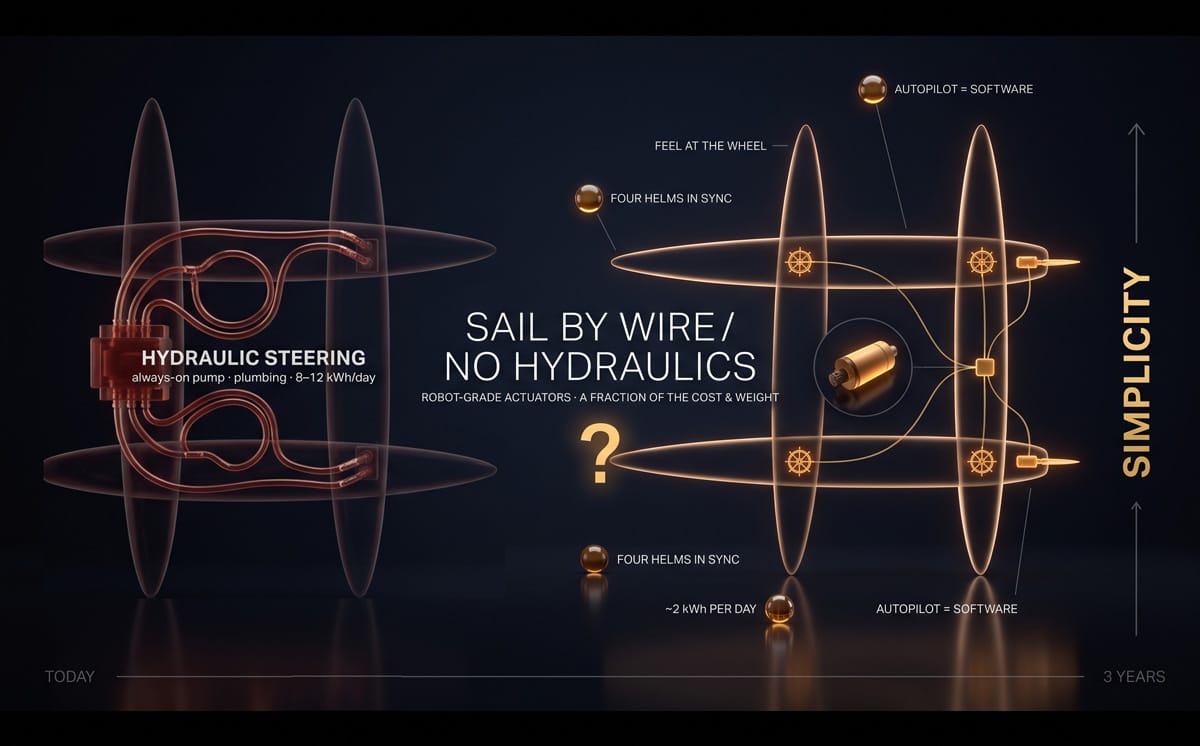
8 Can you steer and sail by wire, with no hydraulics?
Steering that draws almost no energy, weighs a fraction of a hydraulic system, and keeps up to four helm stations in perfect sync — with genuine feel at the wheel, not a synthetic imitation of it.
THE ROBOTICS LESSON
The robotics industry — humanoid and legged robots, exoskeletons, industrial arms — has spent the last decade commoditising something marine has always paid dearly for: compact actuators and encoders with force feedback built in. A single sealed unit now combines the motor, the gearbox, dual position encoders and a closed-loop force drive, produced in volume for robot joints. Alongside them, the off-highway and construction-equipment world has replaced hydraulic cylinders with smart electric actuators built for shock, vibration, salt spray and wash-down.
Both industries moved for the reason that matters most at sea: an electric actuator draws power only while it is actually moving, and idles at a few watts the rest of the time — whereas a hydraulic system must hold pressure continuously, whether anything is moving or not. These units also report their true load and are back-drivable, so the machine can feel what it is doing and can still be moved by hand with the power off. Robotics has proven that electric actuation replaces hydraulics even at large forces — multi-tonne line pulls included — without the pump, the plumbing or the standing energy penalty.
MARINE HAS A SIMILAR OPPORTUNITY
A performance catamaran is the ideal place to apply it. Safiery’s sail-by-wire replaces hydraulic steering with compact helm units only about 60 mm across — each one simultaneously the wheel’s position encoder and its feel motor — driving electric rudder actuators through a single safety-certified controller. Up to four helm stations run together: every wheel is servo-synchronised to the one in command, so all of them move as if mechanically linked, and a TAKE HELM control hands authority cleanly between them.
The feel is measured, not invented. The load on each rudder blade is sensed at the blade and replayed as resistive torque at the active wheel, so the helmsman feels real weather helm, real lee helm, and the load building in a gust — the signal simply travels as electricity instead of through cables and quadrants. A catamaran’s two rudders give the system its own redundancy: each hull’s actuator, sensor, bus and battery feed is independent, so a fault on one side leaves full steering on the other. And with all power lost, the actuator back-drives so the emergency tiller still works.
The result is robotics economics landing on the water. Steering that a hydraulic power pack would cost eight to twelve kilowatt-hours a day runs on under two — steering effectively stops costing battery. Weight and plumbing disappear: no pump, no hoses through both hulls, no fluid, no bleeding. The hardware is roughly 85% cheaper than an incumbent hydraulic steer-by-wire system. And best of all, once this certified wheel-to-rudder foundation exists, autopilot is a pure software layer — a virtual helm station commanding the same actuators, with no additional steering hardware. Auto-sailing and auto-docking ride the same foundation. The investment is made once, in the wire.
9 Can your boat dock itself — safely — in the dark and the rain?
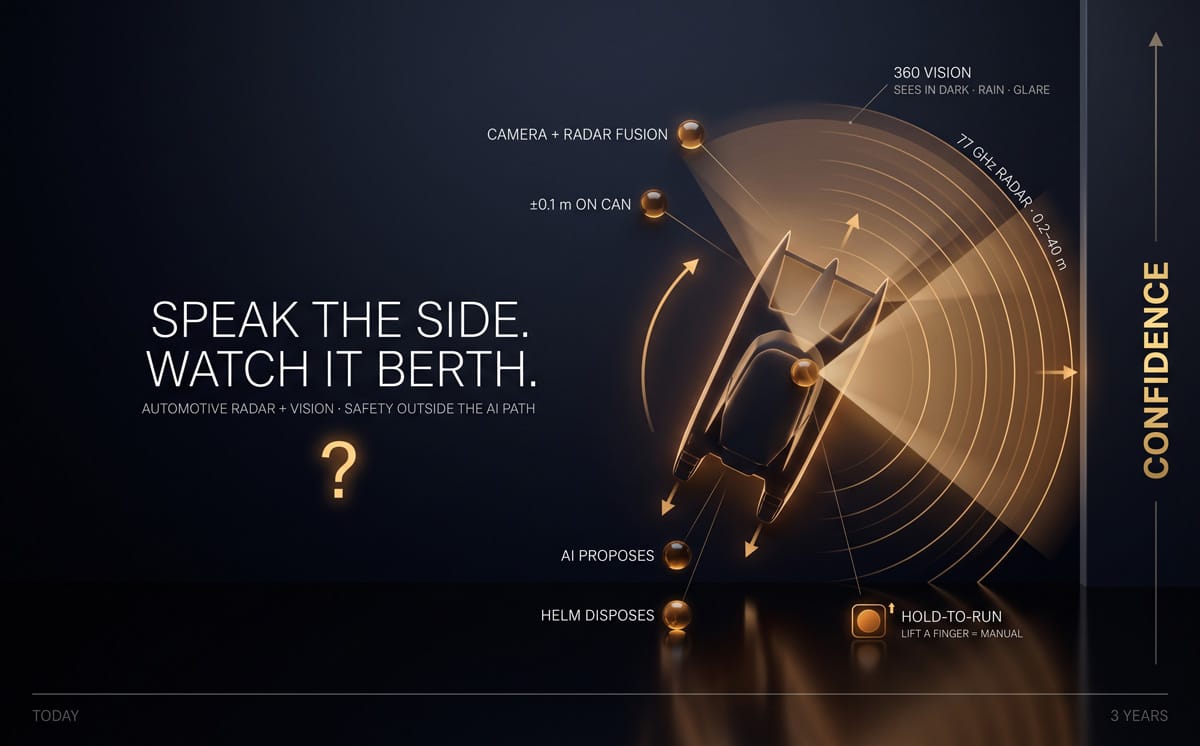
Say which side, hold the button, and watch the boat crab sideways onto the berth — seeing the dock the way a self-driving car sees the road, with the human hand always one release away from taking over.
THE AUTONOMY LESSON
The companies furthest ahead in autonomy don’t trust a single sense. Waymo — which has run millions of fully driverless miles — fuses cameras with radar and lidar precisely so the vehicle keeps seeing when one input is blinded by glare, rain or darkness; its own stated principle is that demonstrably safe AI needs equally resilient inputs. The lone holdout betting on cameras alone is Tesla; the serious safety case elsewhere is built on sensor fusion and redundancy, not on one lens.
The radar in that mix is the quiet hero. Millimetre-wave automotive radar measures range and closing speed as physics, not inference — and it works in the dark, in fog, in rain and in the low-sun glare that defeats a camera. A decade of automotive volume has made it cheap, rugged and weatherproof, and it reports natively on the same CAN bus a vehicle already runs. That is a sensor built for exactly the moment when vision fails.
MARINE HAS A SIMILAR OPPORTUNITY
OBOS takes the same multi-sensor doctrine to the dock. Auto-docking fuses a 360° camera view of the berth, piles and cleats with 77 GHz automotive radar — and the radar is not one sensor but a module carrying five distinct radar modes, covering everything from 200 mm at the fender to 40 m across the harbour. It measures the dock to within about 100 mm, in darkness, rain and glare, and reports on CAN just as it does in a car. An electric catamaran is close to the ideal platform for it: twin widely-spaced electric shafts give precise, instantly reversible thrust, the fly-by-wire rudders turn prop wash into sideways force, and a bow thruster completes the set — so the boat is fully controlled in every direction and can crab bodily sideways onto the berth.
The safety architecture is the part that matters most, and it follows the same doctrine as every OBOS module: the AI proposes, certified deterministic control disposes. The learned docking function suggests a path; the lockstep controller executes it inside hard limits it enforces itself; and the radar feeds an anti-collision watchdog wired straight to that controller — so the boat’s last line of protection involves no AI at all. The skipper picks the side by voice, then holds a button down for the whole manoeuvre. Lift a finger, for any reason, and the boat is instantly back in manual. Human authority is physical and absolute.
And it learns. Because every manual docking is already recorded through the digital twin, the system trains on the skipper’s own approaches — shadow first, then assisted, then supervised automatic — berth by berth, with the home marina becoming a high-confidence, remembered manoeuvre. For the owner, single-handed docking of a sixty-foot catamaran stops being the most stressful ninety seconds of the day. For the builder, it is a demonstrable, deal-closing capability that rides entirely on hardware the boat already carries — sensing and software only, because the actuation was paid for once, in the wire.
10 – The Finale – Should your systems live behind a wall, or in a hybrid cloud?
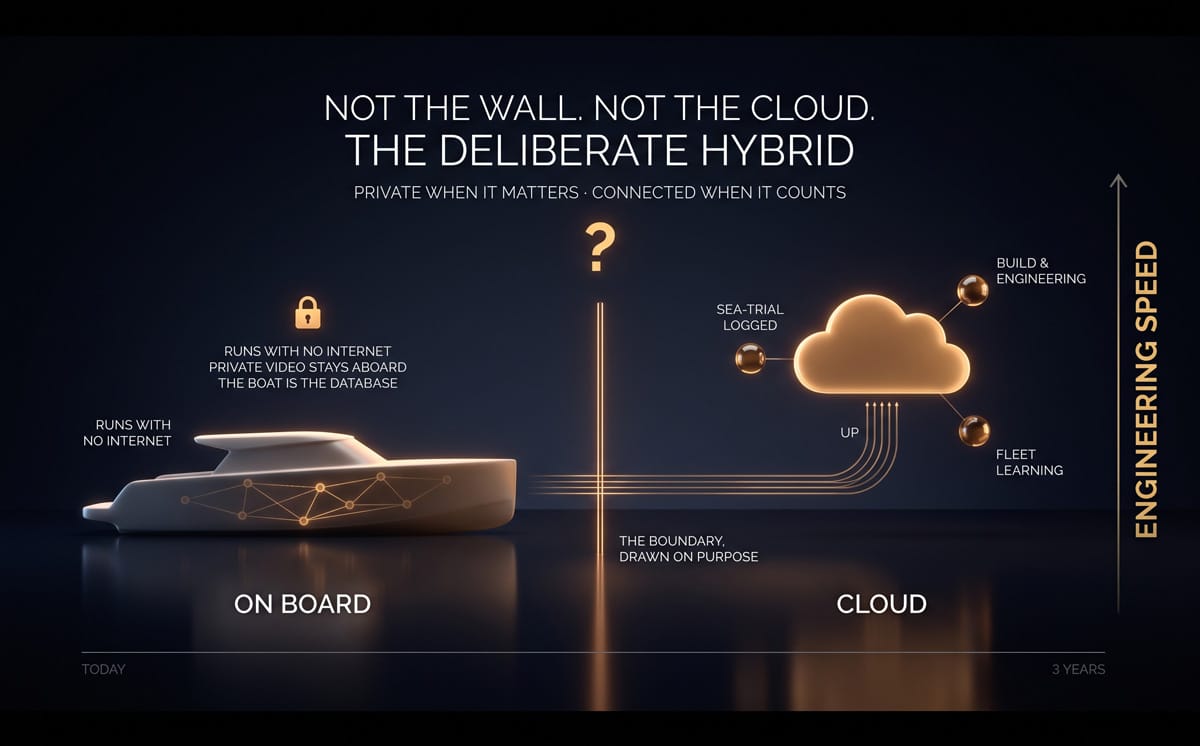
The boat needs to run with no internet, and keep some video entirely private — yet the build, the engineering and the sea trial are transformed by being connected. The answer isn’t one or the other. It’s both, done deliberately.
THE BIG-TECH LESSON
For most of its history IBM was the definition of the walled garden: buy the Big Blue hardware, run the Big Blue software, or don’t play. Then in 2018 it made one of the great pivots in enterprise computing — acquiring Red Hat and betting the company on hybrid cloud and open source. The reasoning its leadership gave was refreshingly unromantic: technology was now moving so fast that no single company, however large, could build the future alone inside its own walls, on its own timetable and budget. Hybrid cloud was the pragmatic answer — keep the sensitive, sovereign data local and secure, but connect to the cloud for the scale, the tooling and the pace that only an open ecosystem can provide.
IBM then doubled down. In March 2026 it completed its $11 billion acquisition of Confluent, the real-time data-streaming platform built on Apache Kafka. The purpose was explicit: to give AI models and agents a stream of live, trusted data flowing across on-premises and cloud environments at once. The lesson for any industry watching: the winning architecture in the AI era is not the wall and it is not the pure cloud — it is the deliberate hybrid, with the boundary drawn on purpose.
MARINE HAS A SIMILAR OPPORTUNITY
Marine systems began as walled gardens too — closed hardware, closed software, closed data. Quasar takes the IBM lesson to the water as a hybrid-cloud architecture, with the boundary drawn where it belongs. The vessel runs fully on its own: the boat is the database, and everything essential works with no internet at anchor, offshore, or mid-ocean. Private video stays on board, inside the vessel’s own network, and never touches the cloud unless the owner chooses. But when connectivity is there, the cloud earns its place — most of all during the build, the engineering and the sea trial, where it changes the economics outright.
That is where the AI wave lands hardest. With the vessel’s live data streaming to the cloud during commissioning, engineering that once happened on board, by hand, one boat at a time, can be done remotely, in parallel, informed by every other hull in the fleet. Systems get designed and signed off in a fraction of the time, with better quality assurance because every circuit and sea-trial test is logged and checked against the fleet, not one person’s memory. The realistic target is designing and engineering a vessel’s systems in around a third of the time it takes today.
For the owner, it means a boat that is private and self-reliant when it needs to be, and quietly improved from ashore when it doesn’t. For the builder, it means engineering capacity multiplied — the ability to ride the tsunami of AI tools arriving now and still coming — rather than being swamped by it. The wall gave you control. The pure cloud gave you scale. The deliberate hybrid gives you both — and that is how marine systems engineering gets built for the next twenty years, not the last twenty.
We have an answer to each of these questions with proven hardware and software.
We call the system QUASAR.
To discuss these questions and your application,
Come to our Stand
1. 315 at IBEX 2026