


Redarc vs Victron and STAR Range: Which 12V Power Management System Is Better?
Choosing between Redarc Electronics and Safiery’s STAR Range affects installation complexity, system integration, future expandability and total cost of ownership. The right choice depends on your preference for proprietary ecosystems versus open standards, installation budget and long-term flexibility needs.
Below is a practical comparison of Redarc vs STAR Range power management systems.
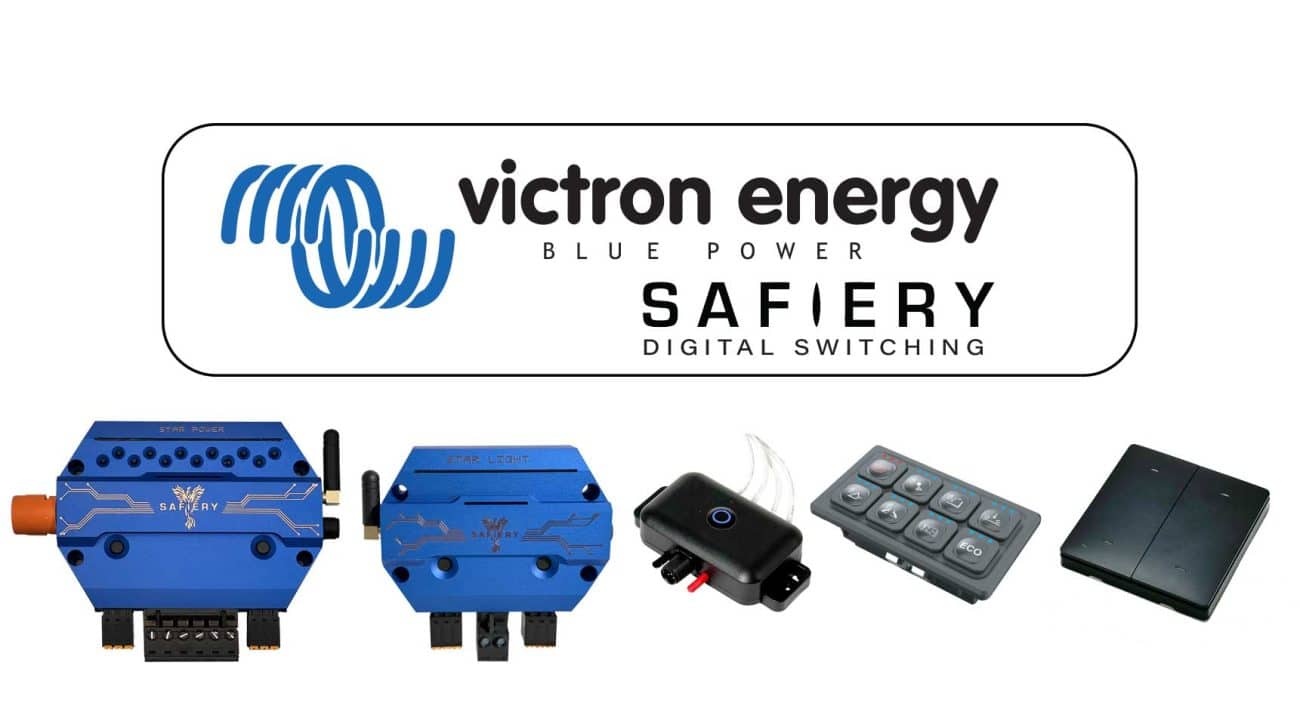
Redarc vs STAR Range: Key Differences
The fundamental difference comes down to architectural philosophy: closed ecosystem versus open standards.
Redarc Electronics, founded in 1979 in South Australia, has built its RedVision Total Vehicle Management System around R-Bus, a proprietary communication protocol connecting Redarc devices exclusively. This creates a coherent ecosystem where components work together seamlessly—but only with other Redarc products.
The STAR Range takes the opposite approach. Built on SAE J1939 and NMEA 2000—internationally published open standards used across commercial vehicles, agricultural machinery, and marine electronics worldwide—STAR controllers communicate with any compliant device from any manufacturer.
This single architectural decision shapes everything: what devices can join your network, how switches connect to controllers, what displays can monitor your system, and how long your investment remains viable as technology evolves.
With Redarc, you’re committed to their product roadmap, their pricing, and their decisions about system capabilities. With STAR Range, you’re free to integrate devices from the entire open-standards ecosystem.
Communication Protocols and Integration
Communication standards determine what your power management system can talk to—and what it cannot.
Open Standards in Communication SMASHES costs and gives customer more choice.
Redarc’s Proprietary R-Bus System
R-Bus connects RedVision components: BCDC Alpha R chargers, TVMS Rogue controllers, Manager battery monitors, and distribution modules. Within this ecosystem, devices share data and allow coordinated control through the RedVision display or smartphone app.
The limitation is exclusivity. R-Bus is not a published industry standard. A Simrad chartplotter cannot speak R-Bus. A Victron Cerbo GX cannot speak R-Bus. A J1939 CAN keypad from any third-party manufacturer cannot speak R-Bus.
This creates vendor lock-in. Adding a third-party BMS, integrating with marine electronics, or using generic CAN keypads requires custom adapters—if solutions exist at all. Future upgrades and expansions depend entirely on what Redarc chooses to develop and support.
STAR Range Open Standards Approach
STAR controllers use SAE J1939, the same protocol running commercial trucks, agricultural machinery, and industrial equipment globally. For marine applications, STAR speaks NMEA 2000, allowing native integration with Simrad, Raymarine, Navico, and Lowrance multifunction displays.
These protocols belong to the world, not to Safiery. Any compliant device from any manufacturer can participate in the network.
For example STAR controllers can co-exist with both Victron and up to 4 different brands of keypads. Safiery sell 2 of these and the others are used by Victron Dealers in USA. There is a good choice available.
J1939 CAN keypads with backlit tactile buttons connect directly to STAR controllers. A single keypad can simultaneously control outputs across multiple controllers—the CAN message broadcasts to all devices without requiring a master hub. Marine chartplotters can directly address STAR switching circuits, changing lighting scenes or activating pumps from the helm display.
This isn’t an integration project. It’s native, standards-based communication working out of the box.
Installation Complexity and Wiring
How switches connect to controllers determines installation time, cable requirements, and total project cost.
Redarc Installation Requirements
Every physical switch in a Redarc system requires a dedicated hardwired cable run back to the TVMS Rogue controller. R-Bus connects Redarc boxes to each other, but it does not eliminate the cables between switches and those boxes.
Want a switch in the cab? Run a cable. Want a switch at the rear of the canopy? Run a cable. Want a two-colour door light switch? Run two cables—one for each colour.
In a typical 4WD with canopy and rooftop tent, this architecture demands approximately 93 metres of cable. Installation typically requires over 23 hours of labour. Cable gauge becomes critical—users report overheating when running BCDC chargers at high output with undersized wiring.
Changing switch placement after installation means running new wire. The physical switch inputs are fixed in location, limiting flexibility for modifications.
STAR Range Wireless Installation
STAR controllers communicate with switches over Bluetooth BLE and open J1939 CAN. A STAR-Switch Wall or STAR-Switch SP4 requires no wiring to the controller at all.
The switch broadcasts directly to the controller wirelessly using a unique UUID address, with blockchain-level encryption ensuring no other device can impersonate it. Up to 80 wireless wall switches can operate on a single system, allowing installers to place control points wherever needed without running cable.
For applications demanding hardwired control—safety interlocks, ignition inputs, reversing light triggers—the STAR-Switch Custom accepts six wired inputs, processes them through programmable logic blocks (AND, NAND, OR, NOR, LINK), then broadcasts the output wirelessly to the controller.
The result: a typical STAR 4WD installation requires just 27.5 metres of cable—a 70% reduction—completing in under 7 hours.
User Interface and Control Options
The interface determines how you interact with your system daily—and what you can actually see and control.
Redarc RedVision Display System
RedVision provides monitoring and control through dedicated displays (like the DISP4300) and smartphone app via Bluetooth. The system shows battery state of charge, load status, and offers master switching capabilities.
However, the interface operates within the Redarc ecosystem only. A Redarc TVMS display controls Redarc devices. A Raymarine display controls Raymarine devices. They do not communicate because one uses a proprietary protocol and one uses open standards.
User feedback indicates the display and app are functional but offer limited customisation. One long-term user reported the “display and app are my least favourite parts… large display gives relatively limited customization.” Remote cloud diagnostics—checking system status from anywhere via internet—appear less developed compared to alternatives.
STAR Range Victron Integration
STAR delivers something architecturally different: a single, unified, professional-grade touch interface combining energy management and digital switching through Victron Energy’s Cerbo GX with Touch 50 or Touch 70 display.
Connected via a single VE.CAN cable, three native STAR-powered display pages appear automatically:
Digital Switching Page—every STAR channel, labelled with custom names, with on/off and dimming control directly from the touchscreen
Power and Energy Page—real-time battery state of charge, solar input, charger output, and load current
Tank and Temperature Page—live readings from wireless STAR-Tank and Ruuvi temperature sensors
The same monitoring and control is available on your smartphone via the Victron app and through the Victron VRM cloud portal, providing remote access from anywhere in the world. For workshops and installers, VRM-based remote diagnostics means problems are frequently resolved without customers taking a short break from their holiday period to drive back for service.
Programming and Configuration
How you set up and modify your system affects both initial installation and long-term maintenance.
Redarc Configuration Process
Programming the RedVision ecosystem requires Redarc’s proprietary configuration software and the Configurator App. Tasks include pairing units through Bluetooth, setting battery chemistry, voltage prompts, current limits, and alarms.
Complex switching logic—scene control across multiple controllers, shared control of outputs from multiple switches, logic gates between inputs—appears more limited than systems designed around programmable logic blocks. Configuration changes often require professional involvement.
Software updates are available over-the-air for newer products like the BCDC Alpha R, which represents next generation capability. However, the programming environment remains tied to Redarc’s tools and approach.
STAR Range Browser-Based Programming
STAR controllers are programmed using any smartphone and a standard web browser—no app download, no software licence, no laptop required.
Hold the left button for 10 seconds, connect to the STAR’s WiFi access point, navigate to 172.24.24.1, and the full programming interface appears. Name channels, set polarity (any channel can switch positive or negative), configure Bluetooth switches, assign CAN keypad buttons, set logic interlocks.
Save the entire configuration as a JSON file. Reload it onto any replacement unit in seconds.
For OEMs and volume manufacturers, this enables a Vehicle Image workflow: configure the complete system on a bench, save the file, flash every production unit identically. Zero on-vehicle programming time. This approach helps manage stock and create consistent builds across production runs.
Battery Charger Cost Analysis and Value
Total cost of ownership includes equipment, installation labour, and long-term maintenance—not just component pricing.
The REDARC BCDC Range includes 12-volt battery chargers that act as a dual battery isolator and charger, supporting AGM, Gel, Lead Acid, and Lithium batteries. The BCDC In-Vehicle DC to DC Battery Chargers can charge auxiliary batteries from a vehicle’s alternator and solar panels simultaneously. The REDARC BCDC Classic 25A DC Battery Charger is designed for under-bonnet or harsh environments, while the REDARC BCDC Classic 40A DC Battery Charger features dual-input charging from both alternator and solar. The REDARC BCDC Core 40A DC Battery Charger is an in-cabin charger that supports dual alternator and solar inputs, and the REDARC BCDC Core 25A DC Battery Charger is the next evolution of the BCDC platform, designed for off-grid applications. REDARC products are known for their ‘six-in-one’ functionality, combining multiple chargers and regulators into a single unit. REDARC also offers Pure Sine Wave Inverters ranging from 350W to 3000W, allowing the use of household appliances while camping. Redarc’s battery management systems (BMS) combine multiple power management functions into a single unit designed for off-grid travel, with multi-source simultaneous charging that allows the BMS to draw power from solar, vehicle DC, and AC mains at the same time. The Manager30 and Manager Alpha are advanced battery management systems that combine AC, DC, and solar charging into one unit, and typically provide real-time monitoring of battery percentage, voltage, and time-to-full or time-to-flat. The REDARC BCDC Core 40A DC to DC In-Cabin Battery Charger is designed for off-grid applications and features advanced charging technology. REDARC’s Smart Start® SBI2 is a microprocessor-controlled battery isolator used in dual battery systems to prioritize charging. The REDARC BCDC Classic 50A DC Battery Charger includes a built-in MPPT solar regulator for efficient solar charging. The Manager Alpha is available in higher capacities (50A, 75A, 100A) for larger battery banks and faster charging.
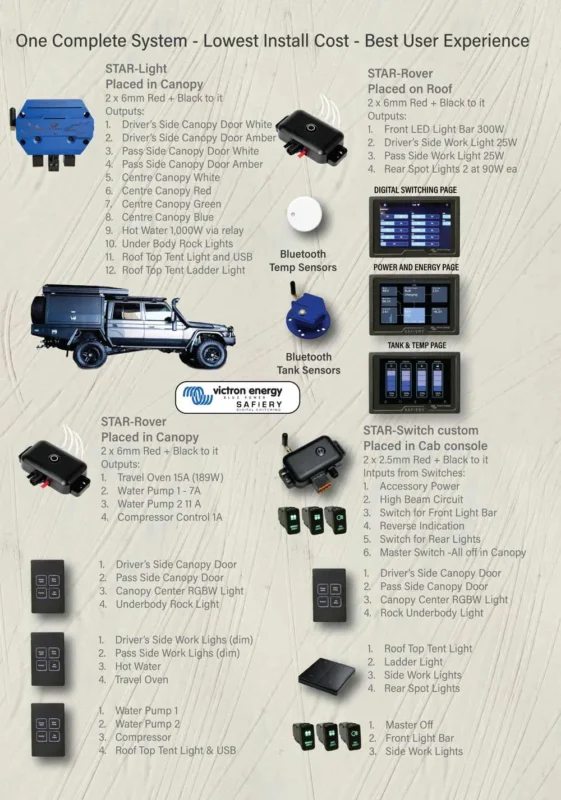
The Installation cost comparison below is based on this Classic Layout above.
| Comparison for Classic 4WD - Digital Switching only. | STAR + Victron | Redarc RedVision |
|---|---|---|
| Cable required | 27.5 m | 93 m |
| Installation time | 6.9 hours | 23.3 hours |
| Installation labour cost | $550 | $1,860 |
| Cable cost | $137 | $465 |
| Total installation cost | $687 | $2,325 |
| Saving with STAR | $1,637 (70%) | — |
Redarc components carry premium pricing, which users accept for reliability and brand assurance. However, the installation cost difference is substantial—and grows with system complexity.
At volume—300 caravans or vehicles per year—installation savings alone exceed $490,000 annually. This number doesn’t account for reduced warranty claims through remote diagnostics capability, elimination of proprietary tooling requirements, or faster service turnaround allowing workshops to check and resolve issues remotely. Please note that installation and service schedules may be affected by the holiday period, with normal operations and shipping typically resuming in January.
For individual builds, the choice often comes down to whether the reliability reputation justifies the additional investment in cable, labour, and installation time.
Next Generation Technology Integration
Technology evolves. The question is whether your power management system evolves with it.
STAR Range is certified for Matter—the IP-based IoT protocol backed by Apple, Google, Amazon, and Samsung. This means STAR controllers work natively with Apple Home, Google Gemini, Samsung SmartThings, and Amazon Alexa today, without modification or additional hardware.
Because Matter, J1939, NMEA 2000, and Bluetooth BLE are all open, published, maintained standards, the STAR system carries an expected communication architecture service life of 20+ years. No single manufacturer can obsolete these protocols.
R-Bus is Redarc’s standard. Redarc’s decisions about R-Bus compatibility, longevity, and supported devices are Redarc’s decisions to make. If a product is discontinued, replacement parts and compatibility depend entirely on their roadmap.
Smart home integration, voice control, and IoT connectivity are increasingly expected in modern caravan and marine builds. Open standards provide a clear path to these capabilities; proprietary systems may or may not follow.
Redarc vs STAR Range: Which Should You Choose?
Choose Redarc if:
You prefer established brand recognition and Australia-based manufacturing heritage dating to 1979
You don’t mind proprietary ecosystems and plan to stay within the RedVision product family
You want traditional hardwired reliability with repair facilities nationwide should things go wrong in harsh conditions
Your installation has a place for extended cable runs and professional wiring
You value the 12V BCDC charging technology and integrated battery charger capabilities for DC battery systems
Choose STAR Range if:
- You value the Victron brand and depth of technology. Victron and Safiery both offer 5 year warranty of products. Victron design for a minimum 10 year product lfe.
- You want open standards integration allowing third-party devices, keypads, and marine electronics to give you flexibility to grow or make changes.
- Installation cost and time are significant factors—particularly for volume builds or OEM applications
- You need unified power monitoring and switching control through a single Victron touchscreen
- Remote diagnostics and cloud-based service access matter for your operation
- Future-proofing through Matter certification and camera integration is important
- Use of CARPLAY or ANDROID AUTO is valuable with the Matter configuration. This co-exists with Victron One Touch Screen.
By application type:
Marine: STAR’s native NMEA 2000 support provides direct chartplotter integration that R-Bus cannot match
4WD/Overland: Both systems perform, but STAR’s wireless switching dramatically reduces installation complexity in tight canopy spaces
Caravan: Volume manufacturers benefit most from STAR’s 70% installation cost reduction; individual builders may accept Redarc’s premium for brand familiarity
Both systems deliver reliable power management when properly installed. The choice ultimately depends on whether you prioritise ecosystem control and brand heritage, or open standards, wireless installation, and unified interfaces.
The number of manufacturers and installers moving toward open standards suggests where the industry is heading. STAR Range doesn’t compete with Redarc on their terms—it plays an entirely different game.
STAR Range. Designed and Made in Australia. Delivered to the World.
www.safiery.com | AI Configurator: ai.safiery.com